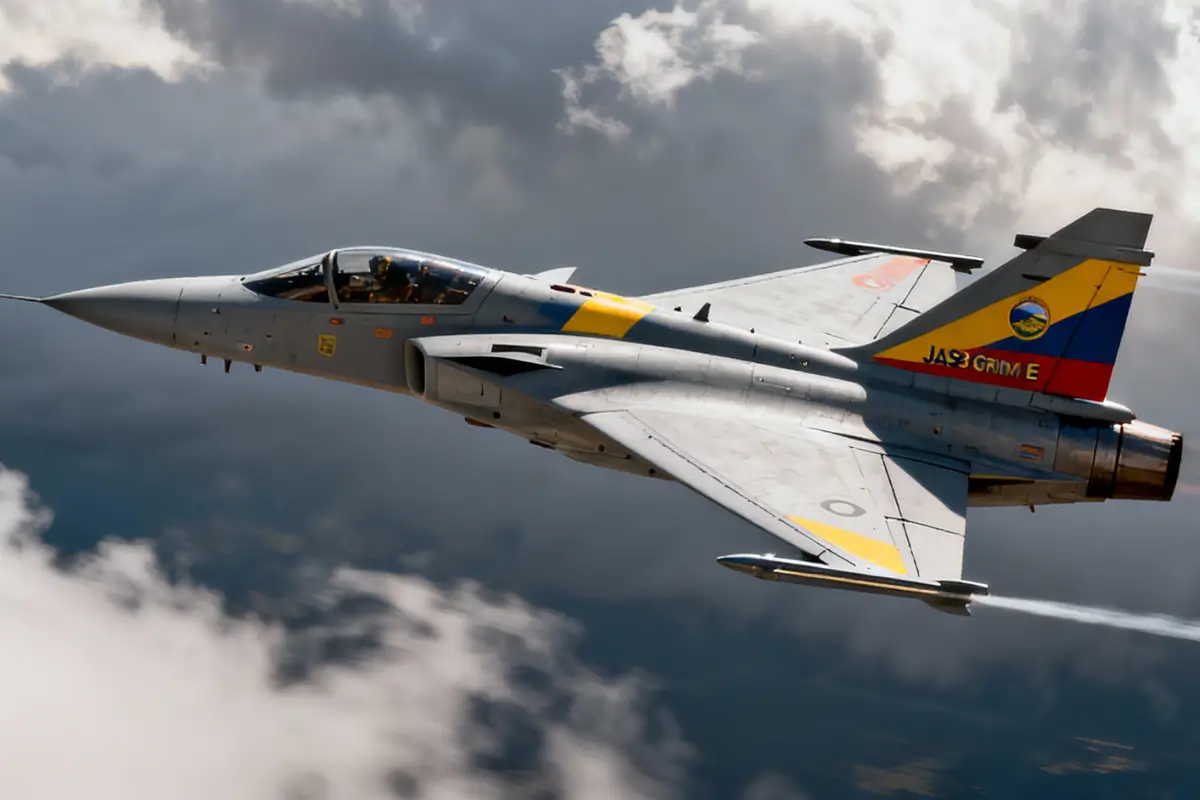
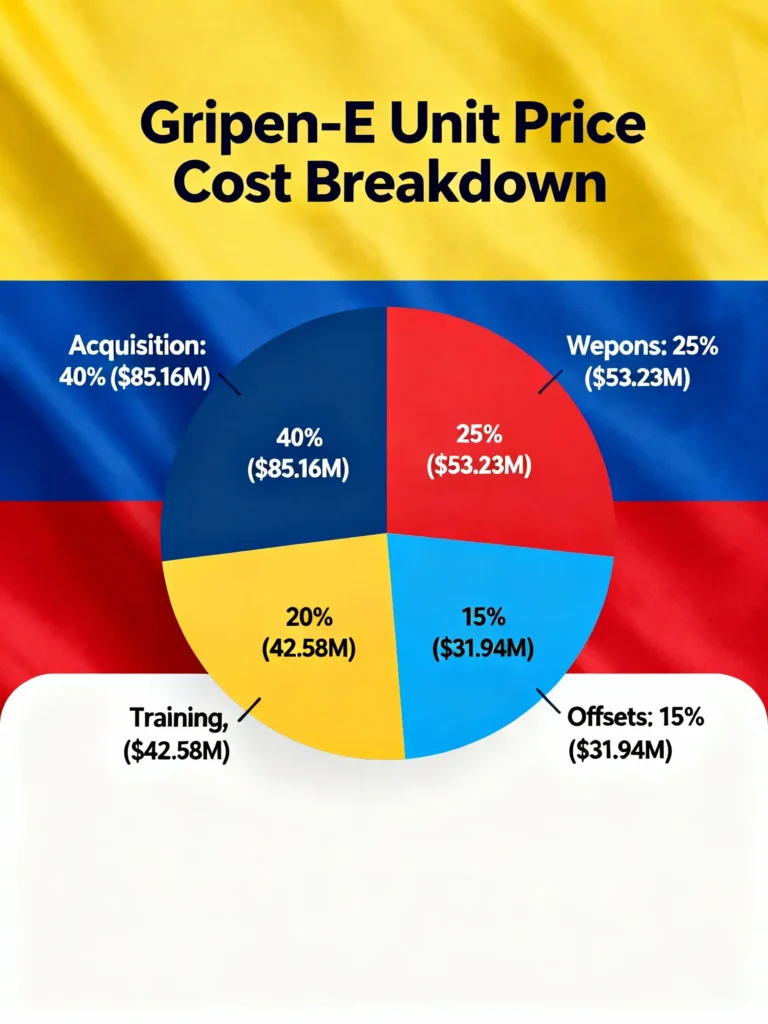
Colombia just made a shocking defence procurement choice that’s reshaping Latin American geopolitics and aviation markets. On November 14, 2025, President Gustavo Petro confirmed: Colombia is acquiring 17 Swedish Saab Gripen-E/F fighter jets for €3.1 billion ($3.6 billion)—translating to approximately $212.9 million per aircraft. But here’s the twist: this price exceeds the F-35A unit cost and approaches the F-16 Block 70’s staggering expense, yet Bogotá deliberately rejected cheaper alternatives. Why? The answer reshapes global defence procurement strategy and matters deeply for India’s own fighter acquisition plans.
Gripen-E Outprices F-35A but Undercuts Operating Budgets
The headline figure stunned analysts. At $212.9 million per Gripen-E (including weapons, training, and full support), Colombia’s deal breaks expectations for the Swedish fighter—historically positioned as the “budget-friendly” option against French Rafale ($150–269 million per unit) and American F-35A ($101.5–135 million per unit). Yet this apparent premium carries a hidden advantage that explains Colombia’s logic entirely.
The Real Story:
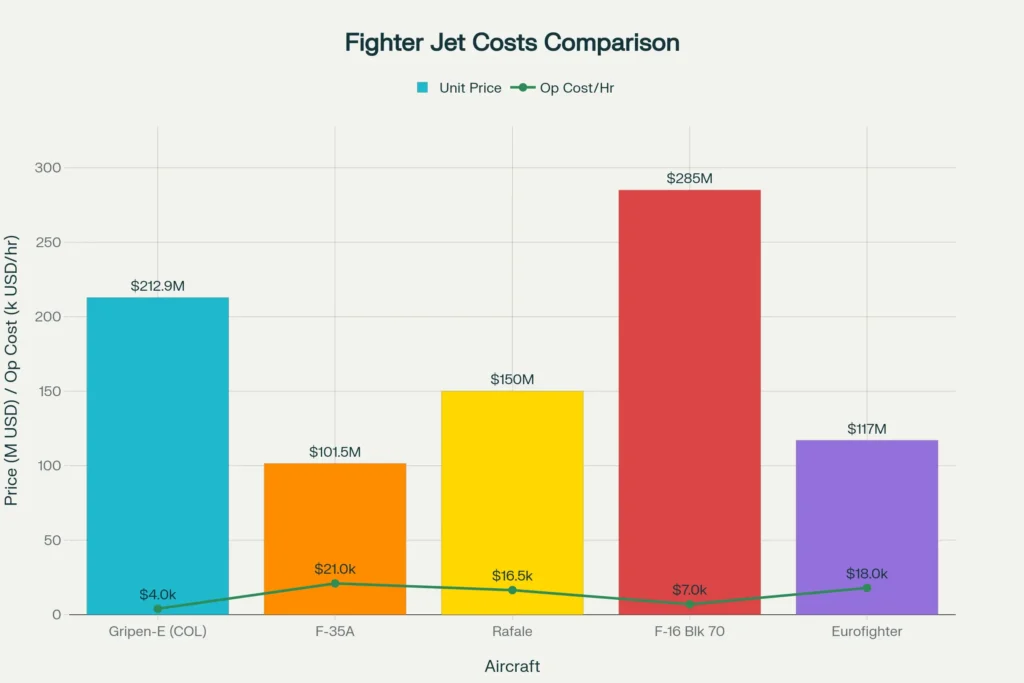
| Fighter Jet | Unit Cost (Millions USD) | Annual Operating Cost Per Flight Hour | Why Colombia Chose Gripen |
|---|---|---|---|
| Gripen-E (Colombia) | $212.9 | $4,000 | Lowest operating expense, industrial offsets |
| F-35A | $101.5 | $21,000 | Cutting-edge but unsustainable lifecycle costs |
| Rafale | $150–269 | $16,500 | French diplomatic strings, high maintenance |
| F-16 Block 70 (Peru’s deal) | $285 | $7,000 | US political leverage; rejected by Colombia |
| Eurofighter Typhoon | $117 | $18,000 | Expensive operations, interoperability gaps |
The Operating Cost Advantage: Gripen-E’s single GE F414 engine costs only $4,000 per flight hour—less than one-fifth of F-35A’s $21,000 and one-quarter of Rafale’s $16,500. Over 30 years, this compounds into billions saved, making Gripen-E the true long-term bargain despite higher upfront acquisition cost.
Why Colombia Rejected the F-16 (and France’s Rafale)
Colombia’s decision isn’t merely financial—it’s a geopolitical earthquake signaling Europe’s re-emergence in Latin American defence and a rebuke to Washington’s traditional dominance in the region. Three factors drove the choice:
1. US-Colombia Tension
President Petro’s leftist government clashed with administration policies over narcotics enforcement, military presence, and Venezuela relations. US-backed F-16 Block 70s carried implicit political strings that Petro rejected, making the Swedish alternative attractive.
2. Swedish Neutrality & Industrial Partnerships
Saab bundled two offset agreements worth billions. Colombia gains technology transfer in aeronautics, cyber security, renewable energy, and water purification—not just military platforms but industrial modernization.
3. Cost of Lifecycle Operations
While F-35A’s acquisition cost appears attractive, Colombia’s military budget cannot sustain $21,000-per-flight-hour operations. Gripen-E’s $4,000/hour model ensures decades of flight readiness without budgetary collapse.
Gripen-E vs. Competitors: The Complete Breakdown
The Swedish single-engine fighter combines maneuverability, sensor fusion, and AI-assisted combat systems in a compact 27-ton airframe. With a maximum range of 2,000 nautical miles and Mach 1.9 speed, Gripen-E delivers 85% of Rafale’s combat power at 40% lower operating cost.
F-35A: Stealth Paradox
America’s stealth fighter offers unmatched sensor networks and survivability but demands enormous logistical ecosystems. F-35 pilots require 400+ flight hours of training, compared to 200 for Gripen-E pilots—compounding lifecycle expenses.
Rafale: Premium European Option
France’s twin-engine fighter excels in range and weapons payload but operates at $16,500/flight hour and carries diplomatic expectations. India pays €269 million per aircraft (nearly $294M)—50% higher than Colombia’s Gripen deal.
F-16 Block 70: Price Explosion
Once the “affordable fighter,” Peru’s recent F-16 deal priced aircraft at $285 million per unit—exceeding even F-35A acquisitions. This price spike emerged from bundled weapons packages, advanced radar (APG-83 AESA), and long-term sustainment contracts, making F-16 no longer the budget choice.
Did You Know?
🚀Colombia's 2026–2032 Delivery Schedule aligns Gripen-E introduction with Brazil and Thailand's own fleet expansions, creating a South American Gripen ecosystem—easing spare parts logistics, training standardization, and collective defence posture against regional threats.
FAQs | Colombia’s Gripen-E Deal Costs
1. Isn’t Gripen-E just a smaller F-16?
No. Gripen-E features delta-canard aerodynamics, AI-assisted combat, and single-engine reliability. It’s fundamentally different—more nimble, less powerful on paper, but operationally superior in tight budgets.
2. Why didn’t Colombia buy used F-16s instead?
he Petro government rejected “hand-me-down” military platforms as colonial geopolitics. New Gripen-E signals sovereign modernization, not dependence on ageing US inventory.
3. What about India? Should we copy Colombia’s playbook?
Partially. India should demand similar industrial offsets and lifecycle cost guarantees but maintain strategic autonomy in fighter selection. Rafale + indigenous Tejas + competing options remain optimal.
4. Will Colombia’s deal trigger Latin American arms race?
Yes. Peru, Chile, Ecuador likely follow. This signals end of US defence monopoly in the region—Europe and Sweden now competitive.
5. How does Gripen-E compare to upcoming Indian fighters?
The Tejas Mark II will offer similar lightweight capabilities with indigenous design. Gripen-E’s proven reliability and operational ecosystem give it immediate advantage, but India’s sovereign platform reduces long-term strategic dependency.
Colombia + Gripen = Strategic Lesson for India’s Fighter Ambitions
India’s ongoing debate over acquiring additional Rafale jets ($294M per aircraft) versus Tejas indigenous fighters versus F-21 Super Hornet mirrors Colombia’s calculation perfectly. Colombia’s Gripen-E choice—prioritizing 30-year lifecycle savings over entry-level acquisition cost—suggests India should:
- Demand offsets like Colombia did: technology transfer in semiconductors, cyber defence, renewable energy.
- Reject political baggage: Don’t accept fighter deals bundled with geopolitical conditions if budget sustainability suffers.
- Evaluate true lifecycle costs: F-35A’s allure fades when India’s annual defence budget of $72.5B must spread across regional security needs.
The Bottom Line: Price ≠ Value in Defence Procurement
Colombia’s $212.9 million per Gripen-E appears expensive against F-35A’s $101.5 million sticker. Yet acquiring 17 Gripen-E jets for $3.6B guarantees:
✅ Lowest-cost operations across 30 years ($4,000/flight hour vs. $21,000 for F-35A)
✅ Industrial sovereignty through Swedish offsets—not political strings
✅ Regional ecosystem with Brazil and Thailand’s Gripen fleets
✅ Geopolitical independence from US-centric defence monopoly
For India, this validates an essential truth: true fighter jet value isn’t price per unit—it’s price per decade of deterrence. Colombia proved that in 2025.
Poll Widget 🎯
Did Colombia Make the Right Choice Choosing Gripen-E Over F-16 and Rafale?
📊 Yes—Smart long-term investment
📊 No—Too expensive for Latin America
📊 Undecided—Depends on execution
Share your vote & debate in comments below!
![Bharat Forge Develops Fully Indigenous Naval Propulsion System for Indian Navy [Explained]](https://ndastudy.com/wp-content/uploads/2026/01/Bharat-Forge-Develops-Fully-Indigenous-Naval-Propulsion-System-for-Indian-Navy-300x169.webp "Bharat Forge Develops Fully Indigenous Naval Propulsion System for Indian Navy [Explained] 4")