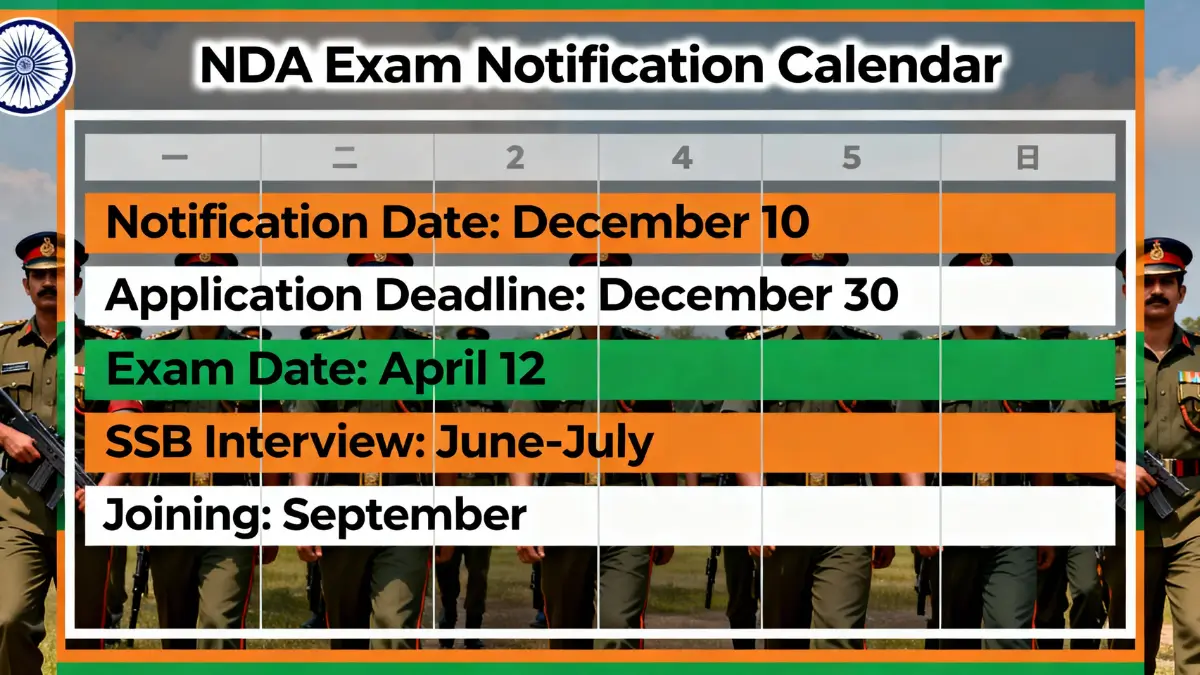
Urgent Alert: NDA 1 2026 notification drops on December 10, 2025 – exactly 8 days from now. If you’re a Class 12 student or 12th passer dreaming of becoming an NDA cadet, this is your final golden window before age limits close permanently. The application deadline is December 30, 2025 (non-negotiable), and the written exam is scheduled for April 12, 2026 – giving you just 120 days to prepare for the most competitive military entrance exam in India. This complete guide breaks down everything you need to know: exam dates, 406 seats available, expected cut-offs, and a day-by-day strategy to crack NDA 2026.
The Complete NDA 2026 Timeline

NDA 1 2026 (Most Important – Happening RIGHT NOW)
Notification Release: December 10, 2025 (Official at upsc.gov.in)
Mark this date in red. At exactly 10:00 AM on December 10, 2025, UPSC will publish the full NDA (National Defence Academy) 1 2026 Notification on its official website. This notification contains everything: exam date, vacancies, eligibility criteria, exam pattern, syllabus, physical standards, medical requirements, and the application process. Do not rely on second-hand information – download the official PDF from upsc.gov.in itself.
Application Window: December 10–30, 2025 (20 days only)
This is your ONLY window to apply. UPSC’s online application portal will remain open for exactly 20 days. During this period, you must:
- Create/login to your UPSC account
- Fill the multi-page application form accurately
- Upload required documents (Aadhaar, 10th/12th certificates, photos)
- Pay the application fee
- Submit and receive confirmation
Critical: The online portal closes automatically at the deadline. There are NO extensions, NO excuses, NO exceptions. If you miss December 30, your only option is NDA 2 2026 (exam September 13).
Exam Date: April 12, 2026 (Sunday)
The written examination will be conducted on Sunday, April 12, 2026, from 10:00 AM to 12:30 PM (Mathematics paper) and 2:00 PM to 4:30 PM (General Ability Test). This gives you 130 days from today (December 2, 2025) to prepare. The exam is objective (multiple-choice) format conducted across hundreds of centres nationwide.
Total Vacancies: Approximately 400–420 seats
NDA 1 2026 will offer around 400–420 vacancies across Indian Army, Navy, and Air Force. This number will be finalized and announced in the December 10 notification. For comparison, NDA 2 2025 had 406 seats; NDA 1 2026 is expected to be similar.
NDA 2 2026 (September Session)
Notification Release: May 20, 2026
If you miss the December 10 deadline or want a second attempt, NDA 2 2026 notification will be released on May 20, 2026.
Application Window: May 20 – June 9, 2026
Twenty-day window, same as NDA 1.Exam Date: September 13, 2026 (Sunday)
Written exam on September 13, 2026. This gives you an extra 5 months compared to NDA 1, which is useful if you need more prep time.
Total Vacancies: Approximately 380–406 seats
Vacancy Breakdown: Where Are the 406 Seats?
Understanding how the 406 seats are distributed across services is crucial because it affects cut-offs and your strategic choices.
Total 406 Seats Divided Across Services
| Service | Approximate Seats | Notes |
|---|---|---|
| Indian Army | 260 | Largest chunk – 10+2 Cadet Entry, various combat and support branches |
| Indian Navy (including INAC) | 80 | Naval Academy + Navy Aviation (pilots, observers) |
| Indian Air Force | 60 | Fighter pilots, transport pilots, navigators, ground officers |
| Coast Guard / Other Services | ~6 | Variable, depends on year |
| TOTAL | 406 | Across all three main services |
These numbers are approximate but consistent year-on-year. The Army gets the majority because it’s the largest service and has the most officer requirements. Navy and Air Force have smaller but highly competitive quotas.
Female Candidates – Now Eligible for ALL Services
This is a game-changer. Until 2024, NDA was predominantly male-only. Now, female candidates are eligible for:
- Indian Army officer positions (all combat and support roles)
- Indian Navy (naval officers, pilots, observers)
- Indian Air Force (fighter pilots, transport pilots, ground officers)
The exact number of female vacancies isn’t specified separately in advance; instead, seats are allocated on merit regardless of gender once the merit list is prepared. Typically, 10–15% of total vacancies end up filled by female candidates based on merit, but this percentage is increasing year-on-year.
For female aspirants: This means the bar to entry is identical to male candidates. The exam is the same, the SSB interview is the same, and the physical standards are the same (with gender-appropriate modifications like running distances). This is a level playing field, and many brilliant female officers have already joined through NDA post-2024. If you’re a girl with the dream of wearing a uniform, NDA is now your direct path.
What Each Service Offers
Indian Army (260 seats):
- Combat roles: Infantry, Artillery, Armor (tank corps), Engineers (combat engineers)
- Support roles: Logistics, Administration, Transport, Signals
- Officers commission as 2nd Lieutenant, undergo 3-year training at NDA
- Post-commission career spans 30+ years with regular advancement
Indian Navy (80 seats):
- Naval Academy officers: Sea-going roles, combat roles on ships/submarines
- Navy Aviation: Pilots (operating naval aircraft), Observers (weapons officers)
- Officers commission as Sub-Lieutenant, specialized training post-NDA
- Naval career offers both land-based and sea-based postings
Indian Air Force (60 seats):
- Fighter pilots: Fly advanced fighter jets like Tejas, MiG-29, Rafale
- Transport pilots: Operate large aircraft (C-130 Hercules, Boeing C-17)
- Ground officers: Radar, maintenance, administration, technical roles
- Officers commission as Flying Officer (pilots) or Flying Officer (ground officers)
Eligibility Criteria: Are YOU Eligible for NDA 2026?
Before you get excited, check these eligibility criteria carefully. Age and educational qualification are strict – no exceptions.

Official Eligibility Requirements
1. Nationality: You must be an Indian citizen.
2. Age (CRITICAL): You must be between 16.5 and 19.5 years old at the time of the exam (April 12, 2026 for NDA 1).
This is calculated as:
- Minimum age: Born on or after December 2, 2009 (to be 16.5 by April 12, 2026)
- Maximum age: Born on or before December 2, 2006 (to be 19.5 by April 12, 2026)
ACTION ITEM: Calculate your exact date of birth now. Check the official notification when released for exact cutoff dates. Age bars are strictly enforced – no relaxation for anyone.
Why such a narrow band? NDA cadets join the academy at age 16.5–19.5, undergo 3 years of training, and commission as officers around age 20–22. This timing aligns with officer recruitment needs and ensures cadets are young enough for physical training demands yet mature enough for officer-level responsibility.
For Class 12 students (2024–25 batch): If you’re currently in Class 12 and planning to appear for NDA 1 2026 in April, you must calculate whether you’ll fall within the age bracket when exam happens. If you’re on the older side (born before Dec 2, 2006), you might already exceed the 19.5 limit by April 2026. This is your last attempt – NDA 2 2026 (September) won’t help if you’re overage for NDA 1 because the age limit doesn’t change.
3. Education: You must have passed Class 12 (10+2) or be appearing for Class 12 exams.
If you’re Class 12 appearing (exam scheduled in board exams March/April 2026), you can apply for NDA 1 2026, but you must provide proof that you’ve appeared for exams before the SSB stage (typically May/June 2026). If you fail Class 12, your candidature is cancelled – NDA doesn’t entertain dropouts.
4. Marital Status: You must be unmarried.
- Male candidates: Must be unmarried at all stages (written, SSB, medical, joining)
- Female candidates: Can marry after joining NDA, but must be unmarried at application and SSB
- Any candidate found to be married at any stage is rejected immediately
5. Nationality of Parents: Both your parents must be Indian citizens (or have acquired Indian citizenship).
If either parent is foreign national, you’re ineligible. This is a strict security-related criterion.
How to Check Eligibility: Your Checklist
Before December 10, confirm:
- Are you Indian citizen?
- Birth date between Dec 2, 2006 – Dec 2, 2009?
- Class 12 passed or appearing in 2026?
- Currently unmarried?
- Both parents Indian citizens?
If you answer YES to all, you’re eligible. If any is NO, NDA isn’t the path (yet).
Cut-Off Trends: What Score Do You Need?
Understanding cut-off trends helps you set realistic targets and assess your progress during preparation.
NDA 2 2025 Cut-Off (Most Recent Data)
Based on official UPSC data from NDA 2 2025 exam:
| Category | Approx. Written Score (out of 900) | Approx. Percentile | SSB Cutoff (if qualified written) |
|---|---|---|---|
| General/OBC (Male) | 450–520 | 65–75 | ~150/300 in SSB |
| General (Female) | 420–480 | 60–70 | ~150/300 in SSB |
| SC/ST (Male) | 380–450 | 50–65 | ~140/300 in SSB |
| SC/ST (Female) | 350–420 | 45–60 | ~140/300 in SSB |
Important notes:
- These are approximate cutoffs; exact numbers vary year-to-year based on difficulty and number of applicants
- A score of 450 in one year might not qualify if difficulty is lower and more candidates score high
- Qualifying written score does NOT guarantee success – you must also clear SSB interview
- SSB has 300-point scale; average qualifying score is around 150, but many score 180–220
Cut-Off Trends Analysis (2023–2025)
Observation 1: Cut-offs remain relatively stable around 450–520 for General category year-on-year. This suggests the exam difficulty is calibrated consistently.
Observation 2: Female candidates have a separate merit list with typically lower written-score cutoffs (~420 vs. 450 for males). Why? Fewer female applications + lower total female candidature means lesser competition in the female merit list.
Observation 3: SC/ST categories have reserved seats (~15% of total 406, so ~60 seats), resulting in lower cutoffs (~380–450). This is intentional government policy for inclusive recruitment.
Observation 4: Vacancies directly impact cutoffs. If vacancies increase (say, 500 instead of 406), cutoffs drop. If vacancies decrease, cutoffs rise. For NDA 1 2026, expect ~400–420 seats, so current cut-off trends should hold.
What Score Should YOU Target?
Target for security: Aim for 550+ out of 900 (top 15–20% range).
This is significantly above cutoff and gives you a safety margin:
- If difficulty is higher than expected, you’re still safe
- Your SSB performance becomes the differentiator (not borderline written score)
- Demonstrates strong fundamentals to interview panel
Component breakdown to reach 550:
- Mathematics: 250+ out of 300 (this is the hardest section; strong Maths = confidence boost)
- General Ability Test: 300+ out of 600 (reasonable; most students score 250–350 here)
Realistic trajectory:
| Month | Expected Score | Notes |
|---|---|---|
| Dec 2025 | 250–300 | Starting level, basics only |
| Jan 2026 | 350–400 | Full syllabus covered, weak in speed |
| Feb 2026 | 450–480 | Decent, but needs speed + accuracy push |
| March 2026 | 520–550 | Target zone; revising weak areas |
| April 2026 (Exam) | 550+ | Goal score |
Reality Check: Cut-Off ≠ Easy Entry
“Cut-off is 450, so I just need 450 to pass” – WRONG THINKING.
- If 50,000 candidates apply for 406 seats (1 in 123 ratio), roughly 1,500–2,000 will make it past written to SSB
- Of those 1,500 going to SSB, only ~800–900 will ultimately get selected (SSB has 40–50% rejection rate)
- Final selection: written score (900) + SSB score (300) = 1200 total points
- Your written score is just 75% of the equation; SSB is 25%
Key takeaway: Scoring 450 might get you to SSB, but SSB performance determines if you actually get selected. A 500+ written score + average SSB performance will beat a 450 written + excellent SSB performance.
NDA 2026 Exam Pattern & Syllabus at a Glance
The Two-Paper Exam Structure
Total Duration: 5 hours (2 papers)
Total Marks: 900
Format: Objective (all multiple-choice)
Negative Marking: Yes (details below)
Paper 1: MATHEMATICS (2.5 hours, 300 marks)
Format: 50 multiple-choice questions, 6 marks each
Syllabus (NCERT Class 11–12 level + some advanced topics):
- Algebra: Sets, complex numbers, quadratic equations, permutation/combination, binomial theorem
- Geometry: 2D and 3D geometry, coordinate geometry, vectors
- Trigonometry: Trigonometric ratios, equations, inverse functions
- Calculus: Limits, continuity, derivatives, applications
- Statistics: Mean, median, mode, probability, standard deviation
- Coordinate Geometry: Lines, circles, conics, 3D geometry
Difficulty level: Class 12 NCERT, but questions emphasize speed and application rather than pure theory
Marking scheme:
- Correct answer: +6 marks
- Wrong answer: -2 marks
- Unmarked question: 0 marks
Strategy to reach 250+ in Maths:
- Attempt 45–47 questions (leave 3–5 difficult ones)
- Ensure accuracy in attempted questions (aiming 90%+ accuracy)
- 45 correct = 270 marks (exceeds target)
- Focus on: Algebra, Coordinate Geometry, Trigonometry (high-frequency topics)
Paper 2: GENERAL ABILITY TEST – GAT (2.5 hours, 600 marks)
Format: 120 multiple-choice questions, 5 marks each
Part A – ENGLISH (100 marks, ~20 questions):
- Vocabulary: Synonyms, antonyms, word meanings
- Grammar: Tense, article usage, error identification
- Comprehension: Reading passages + questions (usually 3 passages, 2–3 questions each)
- Sentence completion, jumbled paragraphs, cloze test
Part B – GENERAL KNOWLEDGE (500 marks, ~100 questions):
This is subdivided into four areas:
- History, Geography, Civics (250 marks, ~50 questions):
- History: Ancient (Mauryan, Mughal), Medieval, Modern India, world history overview
- Geography: India’s states, capitals, rivers, mountains, climate zones, natural resources
- Civics: Indian Constitution, President/PM roles, Defence Ministry, Parliament, National Security Council
- Science (150 marks, ~30 questions):
- Physics: Motion, forces, energy, simple machines, light, sound (Class 10–12 level)
- Chemistry: Atomic structure, bonding, reactions, periodic table
- Biology: Cell structure, genetics, ecology, human body systems
- Current Affairs & Defence (100 marks, ~20 questions): ← Your S-400 article fits here!
- Recent defence news: acquisitions, exercises, treaties (S-400, Agniveer, DRDO)
- Defence budgets, military modernization
- Recent exercises (joint operations, naval exercises)
- International relations affecting India
- General Awareness & Reasoning (50 marks):
- Spatial reasoning, pattern recognition, logical deduction
- GK facts: capitals, currencies, UN organizations
- Current events: elections, natural disasters, sports
Marking scheme:
- Correct answer: +5 marks
- Wrong answer: -1.67 marks
- Unmarked question: 0 marks
Strategy to reach 300+ in GAT:
- English: Attempt all 20; aim 70% (14 correct = 70 marks)
- History/Geography/Civics: Attempt 40–45; aim 80% (36 correct = 180 marks)
- Science: Attempt 25–28; aim 70% (19 correct = 95 marks)
- Current Affairs/Defence: Attempt all 20; aim 90% (18 correct = 90 marks)
- Reasoning: Attempt 10–12; aim 60% (7 correct = 35 marks)
- Total: ~470+ marks in GAT (exceeds 300 target)
What You MUST Know for NDA 2025–26 Current Affairs Section
The GAT includes 100 marks of current affairs + defence knowledge. Here’s what to focus on:
Defence News Topics (Publish articles on these):
- S-400 missile system, Operation Sindoor, India–Russia defence ties
- Agniveer scheme, recruitment trends, troop shortfall
- DRDO projects, indigenous weapons (Brahmos, Astra, Tejas)
- Defence budget, spending trends, military modernization
- Recent exercises: Operation Sindoor, naval exercises, joint training
- Border tensions: LAC (India–China), LOC (India–Pakistan)
- New defence deals, defence partnerships (USA, France, Israel)
Geography for NDA:
- India’s states, capitals, union territories
- Rivers: Indus, Ganga, Brahmaputra, tributaries
- Mountain ranges: Himalayas, Western Ghats, Eastern Ghats
- Strategic locations: Ports (Mumbai, Kochi), border areas
- Climate zones, monsoon patterns, natural resources
History for NDA:
- 1962 India–China war, causes, lessons
- 1965 and 1971 India–Pakistan wars
- 1999 Kargil conflict
- India’s independence struggle (key figures, events)
- Partition, integration of princely states
Civics for NDA:
- Constitution: Preamble, fundamental rights, duties
- President (role, powers), Prime Minister (role, powers)
- Defence Ministry, Services Chiefs hierarchy
- National Security Council (members, role)
- Parliament, Lok Sabha, Rajya Sabha functions
Current Events to track (December 2025 – April 2026):
- New defence announcements
- Political developments affecting security
- International relations (India–USA, India–Russia, India–China)
- Economic trends (inflation, defence spending)
- Sports achievements (especially military personnel)
You have 120 days from today (December 2, 2025) to April 12, 2026. Here’s a structured plan:
Phase 1: December 2025 – Mid-January 2026 (6 weeks) – FOUNDATION
Goals:
- Cover full NCERT Class 11–12 Mathematics
- Complete basic GK (Geography, History, Civics)
- Build strong foundation, not speed
Daily Schedule (4 hours):
- Hour 1: Mathematics – NCERT reading + understanding concepts
- Hour 1.5: Mathematics – solved examples, practice problems
- Hour 1: GAT/GK – History, Geography, Civics from standard books
- Hour 0.5: Current affairs – read defence news, NDA-related websites
Resources:
- NCERT Class 11–12 Maths textbook (full)
- GK books: Lucent’s GK, NIOS materials, Manorama Yearbook
- Websites: Defence.in, Indian Express, The Hindu (defence section)
- Your NDA Study website articles (S-400, Agniveer, etc.)
Milestone by end of January:
- Completed NCERT Maths chapters 1–15
- Revised basic Geography, History, Civics concepts
- Read 30–50 defence news articles + notes
- Able to attempt 40–45% of Maths questions correctly
Phase 2: Mid-January – March 1, 2026 (6 weeks) – SPEED & ACCURACY
Goals:
- Shift from understanding to speed
- Take full-length mock tests
- Refine exam strategy
Daily Schedule (5 hours):
- Hour 1.5: Maths – mixed topics, timed practice (1–2 questions per minute)
- Hour 1.5: GAT – Reading + practicing comprehension, English grammar
- Hour 1: Current affairs + GK – Read latest defence news, create 1-page summaries
- Hour 1: Full mock test (1 every 3 days)
Mock Tests:
- Take 2–3 full-length mock tests per week
- Time yourself strictly (2.5 hrs Maths, 2.5 hrs GAT, no break)
- Analyze every wrong answer – understand why you got it wrong
- Track your improvement
Resources:
- UPSC NDA previous year papers (2015–2025)
- Online mock test platforms (Testbook, StudyIQ, etc.)
- Topic-wise practice books for Maths (RD Sharma for advanced)
- GK books + newspapers (The Hindu, Indian Express)
Milestone by March 1:
- Completed 20–30 full-length mocks
- Scoring 480–520 in mocks consistently
- Maths speed: Completing 45+ questions in 2.5 hours
- GAT accuracy: 75%+ on familiar topics
Phase 3: March 1–12, 2026 (2 weeks) – FINAL REVISION & CONFIDENCE
Goals:
- Revise weak areas
- Maintain fitness
- Build confidence
Daily Schedule (3–4 hours):
- Hour 1: Maths – Revision of weak chapters, speed drills
- Hour 1: GAT – Quick revision of important topics, 2–3 previous year papers
- Hour 1: Physical fitness – Running, push-ups, endurance (SSB will test this)
- Hour 0.5–1: Read defence news, think about SSB answers
What NOT to do:
- Don’t learn new topics; you’ll panic
- Don’t take too many new mocks; trust your preparation
- Don’t overthink; sleep well
Milestone by April 10:
- Scoring 550+ in final mocks
- Revised all weak areas
- Physically fit (can run 5 km in reasonable time)
- Mentally confident (“I can do this”)
Daily Routine Template (Adjust per phase)
6:00 AM: Wake up, 30-min jog/exercise
6:45 AM: Breakfast
7:00 AM – 8:30 AM: Maths (focused, NO distractions)
8:30 AM – 9:30 AM: Break + snack
9:30 AM – 11:00 AM: Maths practice / mock Maths
11:00 AM – 12:00 PM: GAT reading / comprehension
12:00 PM – 1:00 PM: Lunch + rest
1:00 PM – 2:30 PM: GAT / Current affairs / GK
2:30 PM – 3:30 PM: Break + snack
3:30 PM – 5:00 PM: Full mock test or topic revision
5:00 PM – 6:00 PM: Analysis of weak areas, note-taking
6:00 PM – 7:00 PM: Evening walk / physical fitness
7:00 PM – 9:00 PM: Dinner + light reading / defence news
9:00 PM: Sleep (8 hrs minimum)
This is an 8-hour study day. Adjust based on school/college schedule if you’re still studying.
Last Chance Warning: Age Limits & Class 12 Aspirants
Attention Class 12 students: It’s important to know the age requirements for competitive exams like UPSC and some defense or entrance tests. Check the exam notifications right away, as some have minimum age limits. This might be your last chance to take these exams before you become ineligible due to your age. Start preparing early.
For Class 12 Students (2024–2025 Batch – Passing in March/April 2026)
If you’re currently in Class 12 (12th standard), NDA 1 2026 (April exam) is your FINAL GOLDEN CHANCE.
Why? Age limits.
If you’re born after December 2, 2006, you won’t reach 19.5 years by April 12, 2026. But if you’re born before December 2, 2006 (older batch), you might already exceed 19.5 by April 2026, making you ineligible. Check your birth date NOW against the official notification on December 10.
If you’re overage for NDA 1 2026:
- You cannot attempt NDA 2 2026 (September) – age limit doesn’t change
- Your only option: Join defence through SSB officers’ pathway (CDS exam), which has different age limits
- For NDA, you’re locked out permanently
Urgent action: Get your birth certificate, verify exact date, and mark your eligibility clearly.
Age Limit Reality – Strictly Enforced
NDA’s age requirement is the most rigid criterion:
- Not a day’s relaxation for anyone
- No appeals process
- No exemptions based on educational delay or personal circumstances
- Overaged candidate = automatic rejection
Thousands of aspirants lose eligibility every year because of age limits. Don’t be one of them.
Strategy for Class 12 Passers (2025)
Timeline:
- December 10–30: Apply for NDA 1 2026
- January–April: Intensive 4-month prep (challenging but doable)
- April 12: Appear for written exam
- June–July: SSB interview (if qualified)
- September 2026: Joining at NDA as cadet
This 1-year journey is tight but possible. Many successful NDA cadets have done it. You need discipline, focus, and clear strategy – which this guide provides.
FAQs | NDA 2026 Full Exam Calendar
1. Is the December 10 NDA 1 2026 notification really the start? What if I miss it?
Yes, December 10 is OFFICIAL. UPSC typically releases notifications on schedule. If you miss it and haven’t applied by December 30, your only next chance is NDA 2 2026 (notification May 20, exam September 13). But if you’re overage by then, you’re permanently locked out. So December 10 is not just “the start” – it’s your lifeline. Mark it in blood.
2. What if I miss the December 30 application deadline?
There is no extension. UPSC’s online portal closes automatically at 11:59 PM IST on December 30. Once it closes, applications cannot be submitted. You’ll have to wait for NDA 2 2026 (May notification, Sept exam). If age is a concern, missing this deadline is career-damaging. Don’t let it happen.
3. Is a 450 score enough to get into SSB? What are my real chances?
Historically, yes – 450 is approximately the cutoff written score. But here’s the reality: If 50,000 candidates apply for 406 seats (1 in 123 ratio), only the top 1,500–2,000 make it to SSB. Of those, only ~800–900 ultimately get selected (50% rejection rate in SSB). So your 450 score might be just above cutoff, but it doesn’t guarantee selection. You also need: (1) decent SSB performance (average 150+/300), (2) medical fitness, (3) physical standards, (4) security clearance. Aim for 550+ written to have a real shot.
4. Can I apply for both NDA 1 and NDA 2 in 2026?
Yes, technically. But practically? If you qualify written exam in April, SSB is scheduled June–July, which overlaps with NDA 2’s (Sept) exam prep. It’s wise to focus fully on NDA 1 (April) rather than trying both simultaneously. Once you finish NDA 1, if you fail, you have time for NDA 2 prep.
5. What’s the advantage of reading defence news like the S-400 deal that NDA Study publishes?
Two major advantages: (1) Written exam: 100 marks of GAT is current affairs/defence GK. Recent news like S-400, Agniveer, DRDO projects appear directly as MCQs. If you’ve read about them, you’ll recognize answers instantly. (2) SSB interview: Officers interviewing you LOVE candidates who follow defence news. When they ask “What’s the latest defence development in India?”, your answer about S-400 + technology transfer shows awareness, strategic thinking, and genuine interest in defence. Candidates who can’t answer such questions are marked as “not serious about defence.” Reading your NDA Study articles + making 1-page notes is a strategic advantage.
6. Is there any age relaxation or exemption for talented students?
No. UPSC doesn’t provide any age relaxation for NDA based on merit, talent, or special circumstances. Age bar of 16.5–19.5 is absolute. No appeals, no exceptions. If you’re overage, you’re out. Period. This is different from civil service exams (UPSC IAS) where SC/ST candidates get age relaxation; NDA doesn’t have this.
7. What happens after I qualify written exam and pass SSB?
After SSB clearance, you undergo a medical examination at a military hospital to ensure fitness standards. If you pass medical, you appear on the final merit list (combined written + SSB scores). Once notified, you join NDA (National Defence Academy) at Khadakwasla, Pune in September 2026 (for April-exam qualifiers) as a cadet (trainee officer). You undergo a 3-year integrated course in academics, physical training, leadership, and military skills. After 3 years, you pass out and commission as an officer (2nd Lieutenant in Army, Sub-Lieutenant in Navy, Flying Officer in Air Force).
8. What’s the difference between NDA and CDS (Combined Defence Services)?
Both lead to officer commissions, but differ:
– NDA: Age 16.5–19.5, Class 12 pass, 3-year training as cadet, then commission
– CDS: Age varies (22–28 for different services), Graduation pass, 6-month training, then direct commission
– For you in 2025: NDA is your current pathway since you’re likely in Class 12. CDS is future option if you’re doing graduation.
Final Motivational Push
You have ONE clear path laid out in front of you:
December 10: The notification drops. Your dream path officially opens.
December 10–30: You apply. This is your entry ticket.
April 12, 2026: Written exam. Your biggest barrier to overcome.
June–July 2026: SSB interview. Where you prove you’re officer material.
September 2026: You join NDA at Khadakwasla. Uniform, sword, oath – all become real.
For Class 12 passers in 2025, this is your FINAL WINDOW. Age limits won’t bend. Time won’t wait. Every day counts.
Right now, on December 2, 2025, you have:
- 8 days until notification
- 28 days to apply
- 130 days to prepare
- One life to shape
Some will waste these 130 days. Most will. You won’t.
Start today. Read defence news. Solve Maths problems. Take mocks. Build yourself into an officer-worthy candidate.
406 vacancies are waiting. Your uniform, your sword, your oath – they’re all locked behind this exam.
120 days. Go.


![Is Mathematics Compulsory for NDA? Arts/Commerce Students Must Read This [EXCLUSIVE ]](https://ndastudy.com/wp-content/uploads/2025/12/Is-Mathematics-Compulsory-for-NDA-300x169.webp "Is Mathematics Compulsory for NDA? Arts/Commerce Students Must Read This [EXCLUSIVE ] 8")


