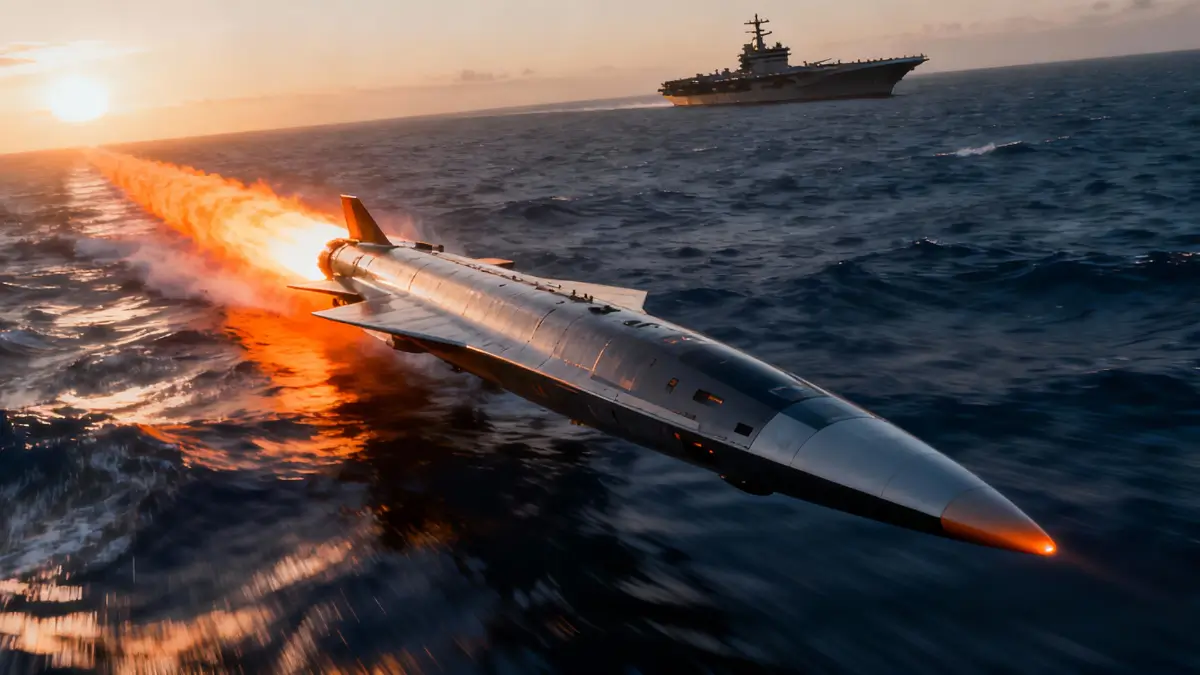
India has changed the naval balance in the Indo-Pacific by successfully testing its Long-Range Anti-Ship Missile (LR-AShM). This test took place on December 1, 2025, and showed that the missile can fly at Mach 10 and hit targets more than 1,500 kilometres away. For many years, aircraft carriers have been the most powerful ships at sea. Now, with the LR-AShM, India sends a strong message to Beijing: the Indian Ocean Region (IOR) is no longer a safe area for enemy carrier strike groups.
What is LR-AShM? India’s Mach 10 Hypersonic Glide Vehicle Explained
The Long-Range Anti-Ship Missile (LR-AShM) is India’s first operational hypersonic glide vehicle (HGV) designed specifically to eliminate high-value naval targets, including aircraft carriers. Successfully tested on November 16, 2024, and again validated in December 2025, this missile represents a quantum leap from India’s existing BrahMos supersonic cruise missile.
LR-AShM Technical Specifications (2025)
| Specification | Details |
|---|---|
| Speed | Mach 10(12,348 km/h or 3.43 km/s) |
| Range | 1,500+ km(official), potentially up to 1,800 km |
| Propulsion | Two-stage solid rocket booster + Hypersonic Glide Vehicle |
| Warhead | Conventional high-explosive, possible nuclear variant |
| Guidance | Active RF seeker + Satellite navigation (NavIC/GPS) |
| Launch Platforms | Land-based TEL, future ship-launched variant |
| Missile Dimensions | ~14 meters length, 1.4 meters diameter |
| Weight | Less than 20 tons |
Unlike ballistic missiles that follow predictable parabolic trajectories, the LR-AShM’s HGV payload “skips” along the atmosphere’s edge, performing evasive maneuvers that make interception nearly impossible for current air defense systems.
Why This Matters: The “Sea Denial” Shift
The LR-AShM is not just a faster missile; it is a strategic “access denial” weapon.
- The Threat: China’s PLAN (People’s Liberation Army Navy) has been rapidly expanding its carrier fleet (Liaoning, Shandong, and Fujian) to project power into the Indian Ocean.
- The Counter: Until now, India relied on the supersonic BrahMos (Mach 3, ~450-800 km range). While deadly, the BrahMos has a shorter reach than the defensive perimeter of a Chinese carrier group.
- The Solution: The LR-AShM breaches that perimeter. At 1,500 km+ range, it allows Indian forces to strike hostile carriers from the safety of the Indian mainland or island territories like the Andamans, long before the enemy gets within striking distance.
Why LR-AShM is a Game-Changer for India’s Naval Strategy
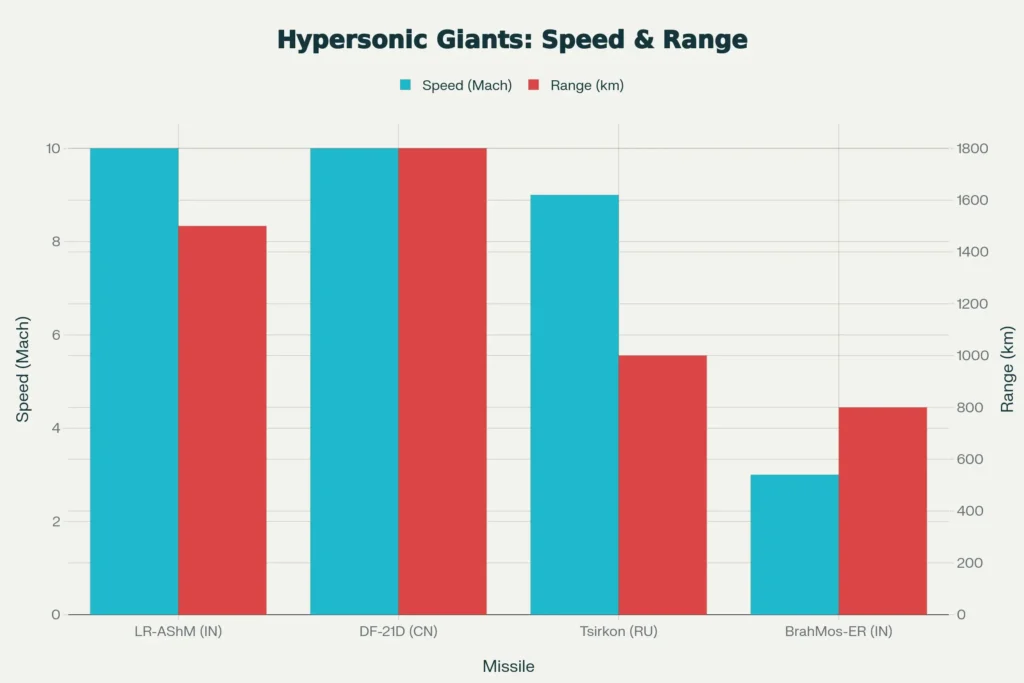
India’s current naval strike workhorse, the BrahMos, cruises at Mach 3 with a maximum range of 800 km in its extended-range variant. While formidable, BrahMos lacks the reach to threaten Chinese carrier groups operating 1,000+ km from India’s coastline.
LR-AShM changes this equation completely:
- 3x the speed of BrahMos (Mach 10 vs Mach 3)
- Nearly 2x the range (1,500 km vs 800 km)
- Unpredictable flight path vs BrahMos’s predictable cruise trajectory
The “Sea Denial” Strategy
The LR-AShM enables India to enforce a 1,500 km maritime exclusion zone around its territory. This means Chinese carriers entering the Bay of Bengal or Arabian Sea would be vulnerable the moment they pass critical chokepoints like the Malacca Strait.
Strategic Outcome: China must now operate its carriers further from India’s coast, reducing their combat effectiveness and forcing them to allocate more resources to self-defense rather than power projection.
LR-AShM vs Global Hypersonic Missiles
India’s Long Range Anti-Ship Missile (LR-AShM) is now capable of flying at hypersonic speeds, which means it can travel faster than Mach 10. It uses advanced boost-glide technology, making it a strong competitor against established global missile systems. The missile’s ability to change direction while flying helps it overcome traditional defense systems.
| Feature | LR-AShM (India) | DF-21D (China) | Tsirkon (Russia) |
|---|---|---|---|
| Speed | Mach 10(Hypersonic) | Mach 10 (Ballistic) | Mach 9 (Scramjet) |
| Range | 1,500+ km | 1,500–1,800 km | ~1,000 km |
| Type | Hypersonic Glide Vehicle (HGV) | Anti-Ship Ballistic Missile (ASBM) | Scramjet Cruise Missile |
| Guidance | Active RF Seeker + SatNav | Radar/SatNav + Maneuvering Warhead | Active Radar Seeker |
| Role | Carrier Killer / Sea Denial | Carrier Killer / A2/AD | Ship Killer |
Performance Analysis
1. LR-AShM (India) vs DF-21D (China)
- Speed Tie: Both claim Mach 10 capability
- Range Advantage China: DF-21D has 1,800 km range vs LR-AShM’s 1,500 km
- Maneuverability: LR-AShM’s HGV design offers superior terminal maneuvering compared to DF-21D’s ballistic reentry vehicle
- Seeker Technology: LR-AShM’s active RF seeker is specifically designed for hypersonic environments, potentially more advanced than China’s aging DF-21D seeker
2. LR-AShM vs Tsirkon (Russia)
- Speed Advantage India: LR-AShM’s Mach 10 exceeds Tsirkon’s Mach 9
- Range Advantage India: 1,500 km vs Tsirkon’s ~1,000 km
- Technology: Both use HGVs, but LR-AShM benefits from 2020s-era computing and materials science
Key Takeaway: While China and Russia fielded hypersonic missiles first, LR-AShM matches or exceeds their performance in key metrics, representing India’s leapfrogging into the elite hypersonic club.
How LR-AShM Specifically Threatens Chinese Aircraft Carriers
China currently operates three aircraft carriers:
- Liaoning (Type 001): 60,000 tons, ski-jump ramp, limited J-15 fighter range
- Shandong (Type 002): 60,000 tons, similar to Liaoning, more operational experience
- Fujian (Type 003): 80,000 tons, electromagnetic catapults, still in sea trials
The Kill Chain
Phase 1: Detection (500-1,500 km)
- Indian Navy’s P-8I Neptune aircraft track carrier group movements
- Satellite surveillance (RISAT series) provides targeting data
- Underwater sensors (SOSUS-style arrays) detect carrier acoustic signatures
Phase 2: Launch (0-500 km from Indian coast)
- LR-AShM launches from mobile TELs or island bases (Andaman & Nicobar)
- Booster accelerates HGV to Mach 10 at 40-50 km altitude
Phase 3: Glide (500-1,500 km)
- HGV detaches, performing evasive maneuvers at hypersonic speed
- Radar cross-section minimized, plasma sheath makes tracking difficult
Phase 4: Terminal Attack (0-50 km)
- Active RF seeker locks onto carrier’s radar signature
- High-speed dive from 40 km altitude at Mach 10
- Impact velocity ensures catastrophic damage even without warhead detonation
Why Carriers Can’t Defend
Current carrier defense systems (like China’s HQ-9 or US SM-6) are designed for Mach 3-4 threats. Against a Mach 10 maneuvering target, reaction time is measured in seconds, not minutes. The LR-AShM’s ability to change course mid-flight means point-defense systems cannot compute an intercept solution before impact.
Deployment Timeline: When Will India Get the LR-AShM?
2025-2027: Critical Phases
| Phase | Timeline | Status | Details |
|---|---|---|---|
| Technology Demonstration | Nov 2024 | ✅ Completed | First hypersonic HGV test from Kalam Island |
| Speed Validation | Dec 2025 | ✅ Completed | Confirmed Mach 10 capability |
| Seeker Testing | 2026 | 🔄 In Progress | Active RF seeker in hypersonic environment |
| Land-Based Deployment | Late 2026 | 📅 Projected | TEL units for Indian Navy |
| Ship-Launched Variant | 2027-2028 | 📅 Projected | Integration with Project 17B frigates |
| Serial Production | 2025-2026 | ✅ Initiated | DRDO confirmed production start |
Integrated Rocket Force Integration
The LR-AShM is not just a Navy weapon. It’s slated for India’s future Integrated Rocket Force, a tri-service command similar to China’s Rocket Force. This means:
- Army: Land-attack variant for deep strikes into Tibet/autonomous regions
- Air Force: Air-launched version for extended range
- Navy: Primary anti-ship role in IORwikipedia+1
Strategic Impact on Indian Ocean Region (IOR)
The LR-AShM fundamentally alters the naval balance in the Indo-Pacific:
For India:
- Deterrence: credible threat to Chinese carrier operations within 1,500 km of Indian coast
- Cost-Effectiveness: One LR-AShM (~$15M) can mission-kill a $6B aircraft carrier
- Technology Leadership: Joins elite hypersonic club alongside US, Russia, China
For China:
- Operating Costs: Must keep carriers further from India, reducing combat radius
- Escalation Risk: Any carrier deployment near India becomes a high-risk gamble
- Force Allocation: Requires more escort ships for missile defense, stretching PLAN resources thin
For Regional Powers:
- Japan, Australia, Vietnam: Watch closely as potential export customers
- Pakistan: Concerned about technology transfer to conventional ballistic missiles
The “Carrier Killer” Arms Race
India’s LR-AShM development mirrors China’s DF-21D/DF-17 and Russia’s Tsirkon. This signals a global shift from traditional naval aviation to hypersonic sea denial. The question is no longer “who has carriers” but “who can kill carriers from 1,500 km away”.
FAQs | India’s Mach 10 “Carrier Killer” LR-AShM
1. What is the exact range of LR-AShM?
Officially stated as 1,500+ km, but analysts suggest the missile may exceed this, potentially reaching 1,800 km depending on flight profile and payload.
2. Can LR-AShM be launched from ships?
Currently in land-based TEL configuration. A ship-launched variant is under development for integration with future Indian Navy warships like Project 17B frigates by 2027-2028.
3. How does LR-AShM compare to BrahMos?
LR-AShM is 3x faster (Mach 10 vs Mach 3) and has nearly 2x the range (1,500 km vs 800 km). While BrahMos is a cruise missile, LR-AShM is a hypersonic glide vehicle with superior maneuverability.
4. Which countries have similar missiles?
China (DF-21D, DF-17), Russia (Kinzhal, Tsirkon), and USA (ARRW – though cancelled). LR-AShM places India in the elite hypersonic weapons club.
5. When will LR-AShM be operational?
DRDO projects operational deployment by 2027 after completing trials in 2025-2026. Serial production has already begun.
6. Can LR-AShM carry nuclear warheads?
Yes, it’s designed as a multi-role platform capable of conventional and nuclear payloads, though its primary role is conventional sea denial.
The Dawn of Hypersonic Naval Warfare
The LR-AShM is not just another missile—it’s India’s declaration of technological parity in the hypersonic era. Achieving Mach 10 speed with a 1,500 km range positions India as a formidable maritime power capable of denying access to even the most advanced naval forces.
For Chinese carriers Liaoning, Shandong, and Fujian, the message is clear: the Indian Ocean is no longer safe operational waters. For India’s Navy, it’s a force multiplier that punches far above its weight. And for global naval strategy, it signals that the age of the hypersonic carrier killer has arrived.
Next Steps: Watch for the 2026 seeker tests and the 2027 operational deployment. The hypersonic arms race is accelerating, and India is now running at the front of the pack.
NOTE: All data sourced from DRDO announcements, Ministry of Defence press releases, and defense analysis from NSDB, IDRW, IDRAW, Naval News, and Defence.in.
Imgaes Credit: NDA Study & Partner Platforms
![Bharat Forge Develops Fully Indigenous Naval Propulsion System for Indian Navy [Explained]](https://ndastudy.com/wp-content/uploads/2026/01/Bharat-Forge-Develops-Fully-Indigenous-Naval-Propulsion-System-for-Indian-Navy-300x169.webp "Bharat Forge Develops Fully Indigenous Naval Propulsion System for Indian Navy [Explained] 3")