Only 120 questions separate you from NDA selection—and 300 marks in mathematics can be the deciding factor between joining the armed forces or going home empty-handed. This is why mastering the NDA mathematics syllabus 2026 isn’t optional; it’s your non-negotiable entry ticket. With a brutal 25% sectional cutoff (meaning you must score at least 75 marks just to qualify), there’s zero room for “I’ll skip this topic” strategies. The mathematics paper is designed to test not just calculation skills but your ability to think strategically, manage time under pressure, and maintain accuracy when the stakes are highest.
Here’s the wake-up call: Algebra + Calculus + Trigonometry = 68% of total marks. That’s 204 marks out of 300. Master these three chapters alone, and you’re already dominant. This article gives you a complete topic-by-topic breakdown of all seven major chapters, exact weightage percentages, exam patterns, study time allocation strategies, and insider preparation tips that coaching centres charge ₹50,000+ to teach. You’ll discover which topics carry the heaviest marks (spoiler: Algebra is your heavyweight champion at 33%), where hidden points are hiding, and how to avoid the costly mistakes that drain marks through negative penalties.
Knowing the weight of each math topic on the NDA exam is your first advantage. It shows you where to focus your study time for the best results. By the end of this guide, you’ll have a clear, actionable roadmap for every chapter—from fundamental concepts to high-value problem-solving techniques—that transforms the overwhelming 120-question syllabus into a manageable, conquerable mission.
NDA Mathematics Exam Pattern 2026 – Quick Overview
The NDA mathematics exam pattern 2026 is designed to test both your speed and accuracy in a high-pressure environment. The paper consists of 120 objective-type questions carrying a total of 300 marks, with a duration of 2.5 hours. The marking scheme is strict: you gain +2.5 marks for every correct answer, while each wrong answer deducts approximately -0.83 marks due to negative marking, making random guessing risky.
The question distribution covers Algebra, Calculus, Trigonometry, Coordinate Geometry, Matrices, Statistics, Probability, and Vectors, ensuring no area can be safely ignored. A crucial feature of the marking scheme is the 25% sectional cutoff—meaning you must score at least 75 marks in mathematics alone to qualify, which forces balanced preparation across all chapters rather than selective study. The exam is conducted in offline mode with an OMR sheet, and you can attempt it in either English or Hindi, but calculators and electronic devices are strictly not allowed, so strong mental calculation and written practice are essential. Notice the 25% cutoff? This means you cannot afford to skip any major topic if you aim to clear the exam confidently.
NDA Mathematics Topic Weightage 2026 – What You Must Know
Understanding the chapter-wise weightage in the NDA mathematics syllabus 2026 gives you a strategic edge—knowing exactly where the marks are distributed lets you prioritise high-yield topics for maximum scoring potential. Algebra & Vector Algebra dominates as the heavyweight at 36-40 questions (90-100 marks, 33% of total), so study it as your selection depends on it (because it does). This heavy emphasis reflects military entrance standards that demand rock-solid algebraic foundations for problem-solving under pressure.
Here’s the complete marks distribution breakdown:
| Chapter | Questions | Marks | % of Total | Priority |
|---|---|---|---|---|
| Algebra & Vector Algebra | 36-40 | 90-100 | 33% | 🔴 Critical |
| Calculus (Diff. & Integral) | 20-25 | 50-62.5 | 18% | 🔴 Critical |
| Trigonometry | 20 | 50 | 17% | 🟠 High |
| Analytical Geometry | 20 | 50 | 17% | 🟠 High |
| Matrices & Determinants | 10 | 25 | 8% | 🟡 Moderate |
| Statistics & Probability | 10 | 25 | 8% | 🟡 Moderate |
| Complex Numbers | 10-15 | 25-37.5 | 10% | 🟡 Moderate |
Key insight: Calculus + Trigonometry together command 35% of marks. Master these two, and you’re already ahead of 70% of aspirants. Algebra’s dominance tests core computation skills essential for defence applications, while Calculus evaluates analytical thinking for real-world scenarios like trajectories and optimisation.
Pro tip: Colour-code your notes by priority—red for critical (Algebra, Calculus), orange for high (Trigonometry, Geometry), yellow for moderate. This topic importance strategy ensures balanced prep without wasting time on low-yield areas, helping you hit the 25% cutoff and beyond confidently.
Algebra – The Foundation (33% Weightage) – Master This First
Algebra topics dominate the NDA mathematics syllabus 2026 with ~40 questions worth 100 marks—that’s one-third of your total score. This massive 33% weightage makes algebra your foundation; without mastering it, clearing the 25% sectional cutoff becomes nearly impossible. Military entrance standards prioritise algebra because it tests core computation speed and logical problem-solving under exam pressure, skills essential for defence officers.
The Big Three Algebra Powerhouses:
- Quadratic Equations (biggest subtopic): Expected 12-15 questions. Master the discriminant (D = b² – 4ac), roots formula x = (-b ± √D) / (2a), sum of roots (-b/a), and product of roots (c/a). These are quadratic equations, NDA favourites—pure scoring machines.
- Progressions: AP & GP are calculation-heavy but high-accuracy topics (15-20 questions likely). Memorize progressions formula: nth term of AP = a + (n-1)d; GP = ar^(n-1); sum formulas S_n = n/2[2a + (n-1)d].
- Permutations & Combinations: Tied to probability. Master the fundamental counting principle: nCr = n! / (r!(n-r)!). Expect 8-10 questions testing selection and arrangement logic.
Complete Key Topics List:
- Quadratic Equations
- Logarithms & Exponentials
- Binomial Theorem & Expansions (a+b)n
- Arithmetic & Geometric Progressions
- Permutations & Combinations
- Sets, Venn Diagrams, De Morgan Laws
- Complex Numbers (i² = -1)
- Linear Inequations
Common mistake: Students skip logarithms—don't. ~5-7 questions test properties like log(a/b) = log a - log b, and they're scoring gold if you know them cold.

Time allocation: Dedicate 25-30% of your study time to algebra (roughly 40-45 hours if total prep is 150 hours). Start here—it's your multiplier.
Quick Checklist:
- ✅ Quadratic formula & discriminant
- ✅ AP/GP nth term & sum formulas
- ✅ nCr/nPr identities
- ✅ Log properties (product, quotient, power rules)
One algebra question solved perfectly = 2.5 marks. Miss one calculation error and lose 0.83 to negative marking. Algebra is your points-scoring machine—treat it like gold.
Trigonometry – The Scoring Section (17% Weightage)
Trigonometry identities and applications form a consistent powerhouse in the NDA mathematics syllabus 2026, delivering 20 questions worth 50 marks. This reliable 17% weightage means if you master this section, you’ll score 45-50 marks easily—your ticket past the 25% cutoff with room to spare. Trigonometry tests practical spatial reasoning essential for defence applications like navigation, artillery angles, and surveillance, making it a staple across exam years.
The 3 Pillars of NDA Trigonometry:
- Identities: Start with the fundamentals—sin²θ + cos²θ = 1 and variants like 1 + tan²θ = sec²θ. Most questions are identity-based; learn the standard 15-20 identities cold.
- Inverse Functions: arcsin, arccos, arctan ranges and properties—3-4 questions guaranteed. Key: arcsin(x) range [-π/2, π/2], arctan(x) range (-π/2, π/2). Master inverse trigonometry formula compositions like sin(arcsin x) = x.
- Heights & Distances: Practical applications shine here. Observer angle problems are examiner favourites—expect 4-5 questions on towers, buildings, and elevation/depression angles using tanθ = opposite/adjacent.
Complete Key Topics:
- Trigonometric Ratios & Identities
- Inverse Trigonometry (arcsin, arccos, arctan)
- Heights & Distances (real-world applications)
- Trigonometric Equations
The trap: Don’t memorise identities—derive them from sin²θ + cos²θ = 1. Derivation = better understanding = better recall under 2.5-hour exam pressure.
Study tips: Graph trigonometric functions (sine wave, period 2π). Visualisation unlocks inverse trig ranges and equation solutions.
Time allocation: 15-20% of study time (20-25 hours). Focus: identities first (40%), inverse trig (30%), applications (30%).
Trigonometry is the ‘golden topic’—high accuracy, consistent difficulty, easy to score. One perfect identity proof = 2.5 marks secured.
Analytical Geometry (Coordinate Geometry) – 17% Weightage
Coordinate geometry commands 20 questions worth 50 marks in the NDA mathematics syllabus 2026, making it a critical 17% scoring block. Geometry is visual—use sketches and diagrams religiously to unlock patterns that pure algebra hides, testing spatial intelligence vital for military mapping, navigation, and targeting systems.
The Breakdown:
- 2D Geometry: Lines + Circles = ~12 questions. Most are formula-based—straight lines equation (y = mx + c, two-point form), circle formula ((x-h)² + (y-k)² = r²).
- Conics: Parabola & Ellipse = ~5 questions. Know standard forms: parabola y² = 4ax, ellipse x²/a² + y²/b² = 1, and focus points.
- 3D Geometry: Distance between points/lines/planes = ~3 questions. Less tested but high-value: 3D geometry distance formula √[(x2-x1)² + (y2-y1)² + (z2-z1)²], direction cosines, direction ratios.
Complete Key Topics:
- Straight Lines (equations, slopes, intersection)
- Circles (standard form, tangent, chord)
- Conic Sections (parabola, ellipse, hyperbola)
- 3D Geometry (distance formula, direction cosines, direction ratios)
- Plane Equations
Critical insight: Most questions are formula applications. Example: “Find the equation of a circle with centre (h,k) and radius r.” Answer: (x-h)² + (y-k)² = r². Plug-and-play mastery.
Study approach: Draw the shape. Label points. Apply formula. This sequence prevents 80% of calculation errors.
Time allocation: 15-20% of study time (20-25 hours).
Pro tip: Master the straight line chapter first—it's foundational for circles and conic sections, parabola, and ellipse. One geometry diagram = multiple questions solved correctly
Calculus (Differential & Integral) – 18% Weightage
Calculus derivatives and integration deliver 20-25 questions worth 50-62.5 marks in the NDA mathematics syllabus 2026, making it the highest-scoring topic per question—2-3 perfect solutions can secure full marks in minutes. This 18% weightage tests analytical thinking for real-world defence applications like projectile trajectories, optimisation, and rate analysis, separating strategic thinkers from rote learners.
The Two Pillars:
- Derivatives: Expect 12-15 questions. Master rules: first principles f′(x) = lim (h → 0) [f(x + h) − f(x)] / h, power rule d/dx (xⁿ) = n xⁿ⁻¹, product/quotient/chain rules + applications (maxima/minima, rate of change).
- Integration: Expect 8-10 questions. Standard integrals + methods (integration by substitution u = g(x), by parts ∫ u dv = uv − ∫ v du + definite integrals ∫ₐᵇ f(x) dx = F(b) − F(a).
Complete Key Topics:
- Limits & Continuity
- Derivatives (first principles, power/product/quotient/chain rule)
- Applications of Derivatives (maxima minima, increasing/decreasing functions)
- Integration (substitution, by parts, standard formulas)
- Definite Integrals & Area Under Curves
- Differential Equations (first-order, first-degree)
Game-changer topic: Maxima & Minima problems—real-world optimisation questions like “maximise area given perimeter.” High-value and frequently tested.
Integration insight: Most questions test integration by substitution. Master u-substitution; it's your go-to technique for 70% of problems.
The trap: Differential equations are easier than they seem. Most NDA questions are first-order, first-degree with standard solutions like separable variables.
Time allocation: 20-25% of study time (30-35 hours). Spend extra on derivatives—they're fundamental for everything else.
Calculus turns complex problems into 2.5-mark wins. Master it, and watch your score soar past the cutoff.
Matrices & Determinants – 8% Weightage (But Don’t Ignore!)
Matrices determinants deliver 10 questions worth 25 marks in the NDA mathematics syllabus 2026—only 8% weightage, but that’s real money in a competitive exam where every mark counts toward the 25% cutoff. These systematic topics test structured thinking for solving linear equations in defence logistics and coordinate systems, making them quick wins if mastered.
The Core Concepts:
- Matrix Basics: Easy marks. Practice operations—addition, subtraction, multiplication (row-column rule).
- Determinants: Use expansion by rows/columns. Properties (row swap = -det, row multiple = k·det) save time.
- Inverse & Adjoint: Key for solving equations. Matrix inverse = adj(A)/|A|. Cramer’s Rule is fastest: x = Dx/D, y = Dy/D.
Complete Key Topics:
- Types of Matrices (square, identity, transpose, symmetric, orthogonal)
- Matrix Operations (addition, subtraction, multiplication)
- Determinants (properties, calculation)
- Inverse of a Matrix & Adjoint
- Cramer’s Rule (solving linear equations)
- Matrix Method for Solving Systems
Time-saving trick: Learn the 3×3 determinant shortcut using the diagonal method: aei + bfg + cdh - ceg - bdi - afh. Faster than cofactor expansion.
Application spotlight: Cramer’s Rule solves 2×2 and 3×3 systems in seconds. Examiners love this topic for its elegance.
Time allocation: 8-10% of study time (12-15 hours). This is an 'easy wins' chapter—focus on core concepts for guaranteed points.
Matrices are systematic. Learn the algorithm, apply it, score consistently.
Vectors & 3D Geometry – Part of Algebra, Separate Emphasis
Vector algebra falls under Algebra’s massive 33% weightage in the NDA mathematics syllabus 2026, with ~8-10 questions testing spatial reasoning crucial for defence applications like force analysis, navigation, and 3D targeting systems.
The Essentials:
- Dot Product: Angle between vectors (cosθ = A·B / |A||B|), parallel/perpendicular check (A·B = 0).
- Cross Product: Area of parallelogram (|A×B|), perpendicular vectors direction.
- Applications: Physics-based—work = F·d, torque = r × F.
Complete Key Topics:
- Vectors in 2D & 3D (magnitude, direction, unit vectors)
- Dot Product & Scalar Product
- Cross Product & Vector Product
- Applications (work, force, moment, geometry)
- 3D Geometry (distance between points/lines/planes, direction cosines)
3D geometry focus: Distance formula √[(x2-x1)² + (y2-y1)² + (z2-z1)²], direction cosines (l,m,n where l² + m² + n² = 1), lines and planes in 3D.
Study tip: Vectors are visual. Draw diagrams. Use component form (i, j, k notation) for clarity.
Time allocation: 10-12 hours (part of algebra study time). Master dot product, cross product for quick wins
Statistics & Probability – 8% Weightage (The Conceptual Topic)
Probability formula applications deliver 10 questions worth 25 marks in the NDA mathematics syllabus 2026—often seen as ‘easy’ 8% weightage, but conceptual understanding is key to avoid traps that cost marks in this competitive exam.
The Breakdown:
- Descriptive Stats: Mean, standard deviation (σ = √[Σ(x-μ)²/n]), variance—mostly formula application.
- Probability: Bayes’ theorem, conditional probability P(A|B) = P(B|A)P(A)/P(B), binomial distribution P(X=k) = nCk p^k (1-p)^(n-k).
Complete Key Topics:
- Mean, Median, Mode, Range
- Standard Deviation & Variance
- Probability Fundamentals (sample space, events)
- Conditional Probability & Bayes’ Theorem
- Combinations & Probability
- Binomial Distribution
Also Know:
The challenge: Students confuse permutation-based probability with combinations. Master the difference: nPr (order matters) vs. nCr (order doesn't).
Bayes’ Theorem insight: Posterior probability questions are high-value. Formula: P(A|B) = P(B|A)·P(A) / P(B).
Time allocation: 8-10% of study time (12-15 hours). Quick to master core concepts.
Probability is about understanding, not memorisation. Once you ‘get it,’ solve any variation.
Common Mistakes to Avoid in NDA Mathematics
Each mistake in the NDA mathematics exam costs you not just marks but cascading negative marking penalties—be meticulous, not hasty. Here’s the top 7 traps that derail aspirants:
- Algebra: Forgetting domain restrictions in logarithm/exponential functions (log can’t take negative). Incorrect root formulas for quadratic equations (discriminant mix-ups).
- Trigonometry: Confusing degree vs. radian mode. Missing angles in inverse trig—arcsin returns only one value in [-π/2, π/2].
- Geometry: Misidentifying conic sections. Forgetting 3D distance formula √[(x2-x1)² + (y2-y1)² + (z2-z1)²].
- Calculus: Chain rule errors (d/dx[f(g(x))] = f'(g(x))·g'(x)). Integration by parts—getting u and dv wrong.
- Matrices: Not checking invertibility before finding matrix inverse (|A| ≠ 0). Incorrect determinant calculation.
- Probability: Confusing “OR” (union, P(A∪B) = P(A)+P(B)-P(A∩B)) with “AND” (intersection).
Negative marking madness: Guessing without calculation. One wrong answer = -0.83, cancelling out 1 correct answer (2.5 - 0.83 = 1.67 net).
Pro tip: When in doubt on an MCQ, skip and come back. Negative marking punishes guesses heavily.
Topic-wise Study Time Allocation & Preparation Strategy
Your NDA mathematics syllabus 2026 preparation succeeds or fails on smart time allocation. This topic-wise study plan assumes 150 total study hours—adjust proportionally if you have more/less time. Prioritise high-weightage chapters first for maximum ROI.
| Chapter | Marks | % Time | Hours (150 total) | Priority | Difficulty |
|---|---|---|---|---|---|
| Algebra | 90-100 | 25-30% | 40-45 | 🔴 Critical | Medium |
| Calculus | 50-62.5 | 20-25% | 30-35 | 🔴 Critical | High |
| Trigonometry | 50 | 15-20% | 20-25 | 🟠 High | Medium |
| Geometry | 50 | 15-20% | 20-25 | 🟠 High | Medium |
| Matrices | 25 | 8-10% | 12-15 | 🟡 Moderate | Low |
| Statistics | 25 | 8-10% | 12-15 | 🟡 Moderate | Medium |
| Revision | — | 10% | 15 | 🔴 Critical | — |
Execution strategy: Start with Algebra (foundation). Then Calculus (high-value). Run Trigonometry & Geometry in parallel. Save 10-15% of total time for revision and mock tests.
Chapter breakdown: 70% concept + practice, 30% revision/formula review.
by NDA Study
Personalisation hint: Weak in Calculus? Allocate 35-40 hours instead of 30-35. Adjust other chapters accordingly. This flexible NDA maths preparation strategy ensures you hit the 25% cutoff with buffer marks.

Revision Checklist – Master the Syllabus Fast
Transform your NDA mathematics syllabus 2026 preparation with this daily, weekly, and monthly revision system. Consistency beats intensity—follow this checklist to build exam muscle memory and crush the 120-question paper.
Daily Revision Checklist:
- ✅ Solve 5-7 mixed algebra problems (daily)
- ✅ Review 1 trigonometry identity + 1 application problem
- ✅ Practice 1 calculus derivative + 1 integration problem
- ✅ Revise geometry concepts using diagrams
- ✅ Solve 1 probability/statistics problem
- ✅ Time yourself on 10 MCQs (simulate exam pressure)
Weekly:
- ✅ Solve 1 full-length practice test (120 questions, 2.5 hours)
- ✅ Review the previous week’s weak areas
Monthly:
- ✅ Redo all chapters you struggled with
- ✅ Update your formula sheet
- ✅ Track accuracy by chapter
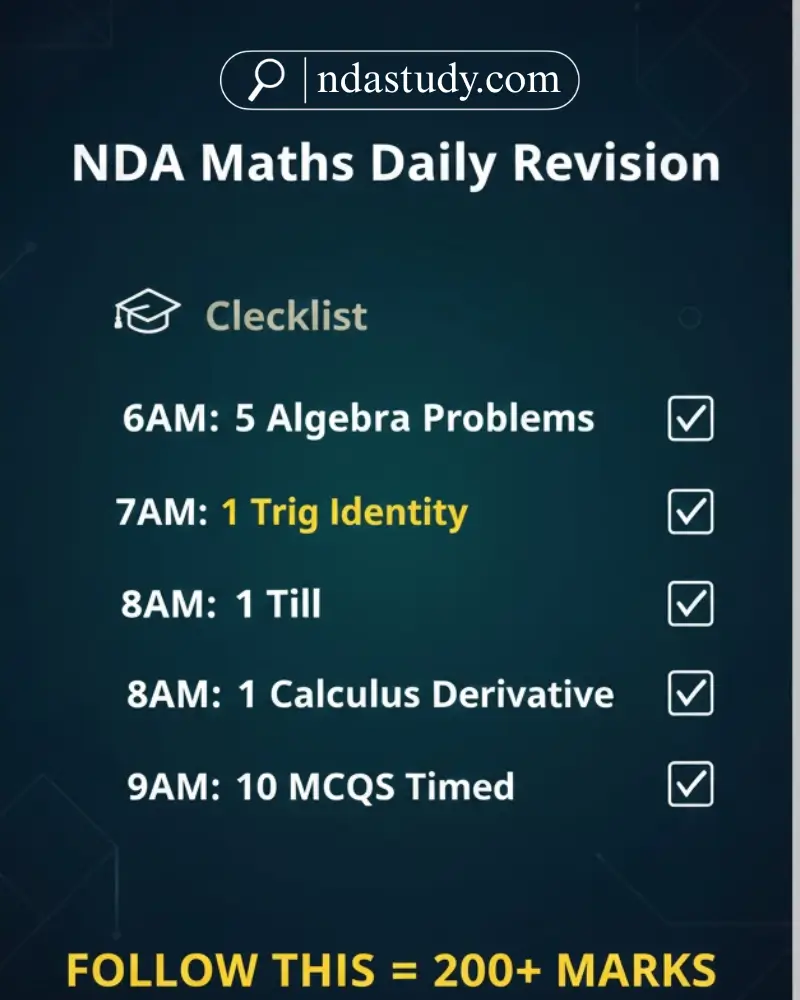
Bookmark this checklist. Print it. Stick it on your study desk. This systematic approach ensures NDA maths topics stay fresh, turning knowledge into automatic recall under exam pressure.
Final Tips to Dominate NDA Mathematics
Execute these 7 power moves to conquer the NDA mathematics syllabus 2026 and secure your armed forces selection:
- Master one chapter completely before moving next. Half knowledge of all chapters < full expertise in high-weightage chapters (Algebra 33%, Calculus 18%).
- Use past 5-year papers as primary practice. Repeat patterns exist—NDA examiners test similar quadratic equations, trigonometry identities, and maxima and minima concepts yearly.
- Create a formula sheet and revise daily. Progressions formula, dot product, cross product, Cramer’s Rule—your weapons must stay sharp.
- Solve in steps, write neatly. Annotate each step during practice. Builds accuracy, saves marks even if the final answer slips (partial credit mindset).
- Simulate exam conditions weekly. 10-question timed quizzes bi-weekly, full 120-question mock tests monthly (2.5 hours, +2.5/-0.83 marking).
- Join a study group. Explaining integration by substitution or Bayes’ theorem to peers solidifies your mastery.
- Track weak areas obsessively. Maintain a “mistake journal.” Revisit chain rule errors and conic sections mix-ups weekly.
Every hour invested brings you closer to selection. Math is your barrier, but also your differentiator. Master it.
FAQs | NDA Mathematics Syllabus 2026
NDA aspirants’ top questions on the mathematics syllabus 2026 answered directly—bookmark these answers for revision:
1. Which is the most important chapter in NDA Maths?
Algebra dominates with 33% weightage (90-100 marks). If time is limited, master Algebra + Calculus first (60% of marks = 190+ marks). These two chapters directly determine your cutoff status.
2. How much time do I need to prepare the full NDA syllabus?
For solid preparation, 150-200 hours over 3-4 months is ideal for competitive scoring. Start 6 months before the exam for psychological comfort and a revision buffer.
3. Should I study Complex Numbers separately or with Algebra?
Complex Numbers are part of the Algebra section (10-15 questions, i² = -1, Argand plane). Dedicate 5-7 hours after basic Algebra foundations—treat as specialised algebra subtopic.
4. What if I’m weak in Calculus?
Calculus is challenging but high-value (18% weightage, 50-62.5 marks). Invest 35-40 hours. Free resources: Khan Academy for derivatives, YouTube for integration by substitution, plus NCERT/RS Aggarwal practice problems.
5. How do I avoid negative marking penalties?
Never guess randomly. If uncertain, skip and return later. Each wrong answer = -0.83 marks; one error cancels 1/3 of a correct answer (2.5 – 0.83 = 1.67 net loss). Be ruthless about accuracy.
6. Is a calculator allowed in NDA Maths?
No. Calculators and log tables are prohibited. Practice mental calculations, approximation techniques, and speed tricks for solving 120 questions in 2.5 hours.
7. Are there any topics I can completely ignore?
No. The 25% sectional cutoff (75 marks minimum) forces balanced knowledge across all chapters. Even 8% weightage topics (Matrices, Statistics = 25 marks) can determine pass/fail.
8. What’s the best way to remember trigonometric identities?
Derive from sin²θ + cos²θ = 1. Understanding beats memorisation. Build compound angle formulas, double-angle identities. Master 20 core identities through daily 5-minute drills.
NDA Mathematics Syllabus 2026 – What Next
The NDA mathematics syllabus 2026 blueprint is crystal clear: Algebra (33%, 90-100 marks) leads, Calculus (18%, 50-62.5 marks) follows, with Trigonometry + Analytical Geometry (34%, 100 marks) completing the high-value trio. This complete roadmap covers all 120 questions, 300 marks, a 2.5-hour exam pattern with chapter-wise weightage, 150-200 hours study allocation, and insider strategies that transform average scorers into toppers. From quadratic equations NDA dominance to integration by substitution mastery, every topic breakdown prioritises your path to the 25% sectional cutoff (75 marks minimum) and beyond.
Follow the topic-by-topic approach—Algebra foundation first, Calculus high-value next, parallel Trigonometry/Geometry, quick wins in Matrices/Statistics—and secure 200+ marks comfortably. Bookmark this guide for daily reference, save it to your planner, and share it with NDA aspirants. Coming soon: “NDA Best Mathematics Books 2026” for perfect resource alignment. NDA maths is conquerable—you have the strategy, weightage intel, and checklist. Execute relentlessly. Every hour invested = one step closer to selection. Dominate.


![Is Mathematics Compulsory for NDA? Arts/Commerce Students Must Read This [EXCLUSIVE ]](https://ndastudy.com/wp-content/uploads/2025/12/Is-Mathematics-Compulsory-for-NDA-300x169.webp "Is Mathematics Compulsory for NDA? Arts/Commerce Students Must Read This [EXCLUSIVE ] 8")