Crack 600 marks in the NDA GAT syllabus 2026? Master this step-by-step syllabus breakdown first.
NDA GAT syllabus 2026 comprises 200 marks English + 400 marks General Knowledge—your gateway to NDA success. This guide cuts through fake “full syllabus” claims flooding online, delivering only UPSC-confirmed topics for the NDA English syllabus and the NDA general knowledge. Quick fact: Only 3% of aspirants master the NDA current affairs section—you’ll join the top tier after reading this. Updated for the 2026 exam pattern, this maps every topic to study, what to skip, and a realistic timeline that works.
NDA GAT Exam Pattern 2026: Quick Overview
The NDA General Ability Test (GAT) is the second paper of the National Defence Academy entrance exam. It’s designed to test your English proficiency and general awareness across science, history, geography, and current affairs.
English Section (200 marks) — Total questions: 50 (4 marks each) | Time allocation: 35 minutes
General Knowledge Section (400 marks) — Total questions: 100 (4 marks each) | Time allocation: 150 minutes
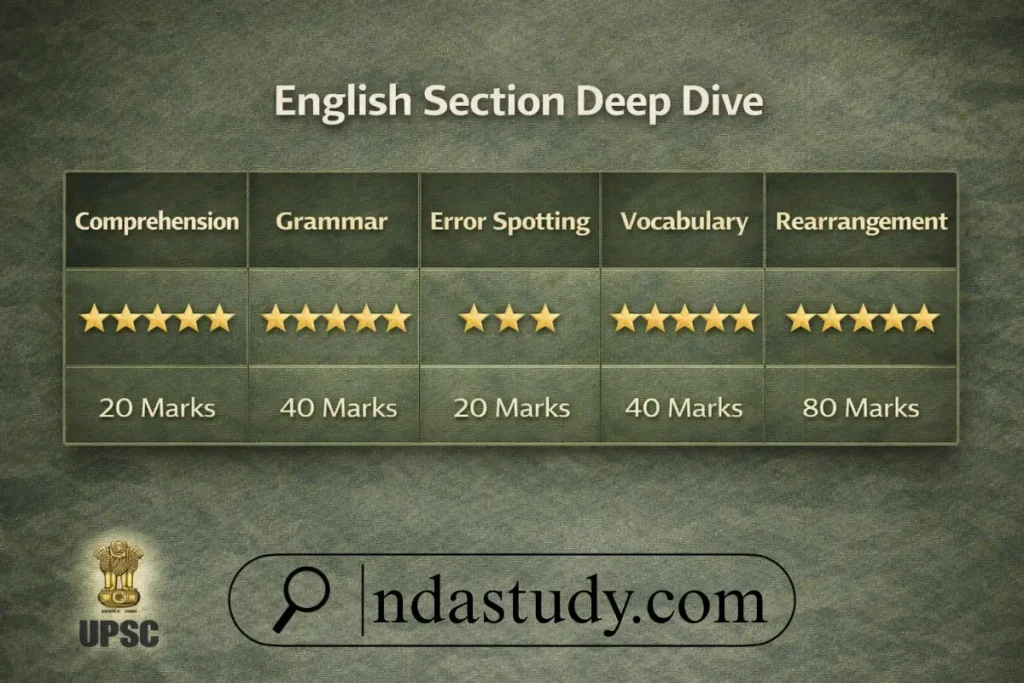
| English Topic | Marks | # Questions | Priority |
|---|---|---|---|
| Comprehension Passages | 20 | 5 | ⭐⭐⭐ (High) |
| Grammar & Tenses | 40 | 10 | ⭐⭐⭐ (High) |
| Error Spotting | 20 | 5 | ⭐⭐ (Medium) |
| Vocabulary & Idioms | 40 | 10 | ⭐⭐⭐ (High) |
| Sentence Rearrangement | 80 | 20 | ⭐⭐⭐ (High) |
| Total | 200 | 50 | — |
The GAT tests practical English and general knowledge—not obscure facts. The exam pattern has remained stable since 2020, making 2026 preparation predictable and strategy-driven.
English Section Deep Dive: Topics You MUST Master
English comprises one-third of your GAT score. Mastering this section separates the top 10% scorers from the rest. Here’s exactly what appears in the exam.
1. Comprehension Passages (20 Marks) — Your Golden Goose
Comprehension is the easiest 20 marks to gain consistently. You’ll face 4–5 unseen passages (200–300 words each) on diverse topics: science & technology, social issues, economics, literature, philosophy, and current events (post-2024).
Question types:
- Factual recall (“According to the passage, what caused…?”)
- Inference (“The author implies that…?”)
- Vocabulary in context (“What does ‘ubiquitous’ mean in the passage?”)
- Author’s tone and intent
Pro tip: Read The Hindu editorial section 15 minutes daily—it mirrors NDA passage style perfectly. Dense, analytical, opinion-driven.
Study strategy: Practice 1 passage daily, time yourself to 4 minutes per passage. After reading, answer questions without re-reading. This builds speed and comprehension simultaneously.
Common pitfall: Over-analysing. Stick to what’s explicitly stated. NDA doesn’t test inference beyond basic logic.
2. Grammar: The Foundation (40 Marks)
Grammar is 20% of English and absolutely testable. Core topics dominate 90% of questions.
Core topics (prioritise in this order):
- Tenses (30% of grammar questions): Simple past, present, future; continuous; perfect forms. Master: “I have been studying” vs. “I am studying” vs. “I study.”
- Subject-verb agreement (20%): Singular/plural nouns, collective nouns, tricky subjects (“Economics is” not “are”).
- Articles (15%): a, an, the—rules and exceptions.
- Prepositions (15%): in, on, at, during, for, by, since, for, during.
- Modals (10%): can, could, should, would, must, may, might usage.
- Conditional sentences: If + subject + verb patterns.
Quick fact: 90% of grammar errors fall into these 6 categories. Master them obsessively.
Resources: NCERT Class 10 English Communicative, Wren & Martin Grammar Guide (selective chapters—don’t read cover-to-cover).
3. Error Spotting & Sentence Improvement (20 Marks)
Error spotting asks you to identify grammatical errors in the underlined sentence portions. This is pure pattern recognition.
Most common errors tested:
- Verb tense inconsistency across clauses
- Subject-verb number disagreement
- Misplaced modifiers
- Parallel structure violations
- Incorrect pronoun references
Study hack: After learning each grammar rule, solve 10 error-spotting sentences immediately. Reinforces pattern recognition faster than theory alone.
4. Vocabulary: Smart Expansion, Not Rote Learning (40 Marks)
NDA tests practical vocabulary, not SAT-level obscurity.
Focus: 500 high-frequency words from competitive exam lists.
Categories to target:
- Synonyms/antonyms of common words
- Idioms & phrasal verbs (10–15 phrases per month)
- Words with multiple meanings (bank, run, table, bear)
Strategy: Learn vocabulary in context via passages, not isolated word lists. A word learned in a passage sticks 5× longer than from flashcards.
Flashcard tip: Use the Anki app with 20-minute daily reviews. Add new words every Monday (weekly batching prevents overwhelm).
Also Read:
Avoid: Memorising obscure words. NDA tests functional vocabulary. If you haven’t seen it in The Hindu, skip it.
5. Sentence Rearrangement & Para Jumbles (80 Marks)
This is the highest-value section of English. Para jumbles appear in sets of 5–7 sentences; you must arrange them logically.
What examiners test:
- Paragraph logic (opening sentence → supporting ideas → conclusion)
- Pronoun references (if Sentence 2 starts with “He,” the pronoun subject must appear in Sentence 1)
- Cause-effect relationships
- Transition signals (However, Therefore, Meanwhile)
Study approach: Start with 2-sentence pairs, build to full paragraphs. Master the pronoun and transition linking first.
General Knowledge: The 400-Mark Fortress
General Knowledge comprises 67% of GAT marks—neglecting it guarantees failure. Physics + History + Geography alone account for 260 marks (65% of GK). Master these three first, then branch out.
Study timeline: 4 months minimum for complete GK (120 hours total).
Physics: 100 Marks — Master These 12 Core Topics
Physics is the single-highest-scoring subject in GK. Master mechanics and thermodynamics first; they account for 60% of physics questions.
High-Frequency Topics (60 marks guaranteed):
Newton’s Laws of Motion & Applications (30% of physics questions)
- Three laws, numerical problems on F = ma, friction, and inclined planes
- Common questions: Lift problems, pulley systems, collision mechanics
- Study resource: NCERT Class 11 Mechanics chapter + 50 numerical problems
- Example: “A 10 kg block on a frictionless surface experiences a 50 N force. Find acceleration.”
Work, Energy & Power (25% of physics questions)
- Work-energy theorem, kinetic/potential energy, conservation of energy
- Typical questions: Roller coaster heights, collision scenarios, power calculations
- Why critical: Appears in 3–4 annual questions
Simple Harmonic Motion (15% of physics questions)
- Pendulum motion, spring systems, equations of SHM
- Why tested: Bridges mechanics and waves conceptually
Medium-Priority Topics (30 marks):
- Gravitation & Orbital Mechanics
- Rotational Motion & Angular Momentum
- Properties of Matter (elasticity, surface tension, viscosity)
- Heat & Thermodynamics (first law, specific heat, latent heat)
Peripheral Topics (10 marks):
- Oscillations, Waves, Light reflection/refraction
Study Strategy:
- Solve numerical problems first—conceptual clarity emerges from calculations
- Create a formula sheet: 20 essential physics formulas with derivations
- Daily target: 1 concept + 5 numericals = 45 minutes
- Mock test approach: Solve past 10 years NDA physics questions (pattern recognition is gold)
Pro Hack: Physics conceptual clarity > memorisation. If you can’t explain it to a 12-year-old, you haven’t mastered it.
Chemistry: 60 Marks — Systematic Coverage Without Overwhelm
Chemistry is 15% of GK, but it is highly testable. Focus on periodic table trends and redox reactions—they appear in 60% of chemistry questions.
Essential Topics (45 marks):
Periodic Table & Element Properties
- Trends: Atomic size, ionisation energy, electronegativity
- Blocks: s, p, d, f blocks; groups and periods
- Memory aid: “Position = Properties”
Chemical Bonding & Molecular Structure
- Covalent, ionic, metallic bonds
- VSEPR theory, electronegativity differences
- Common questions: Bond order, polarity, structural formulas
Redox Reactions & Oxidation States
- Balancing equations using the half-reaction method
- Oxidation number rules (5–6 key rules to master)
- Application: Electrochemistry, corrosion
Acids, Bases & Salts
- pH scale, strong/weak acids, buffer solutions
- Neutralisation reactions, titration concepts
- NDA focus: Practical application scenarios
Secondary Topics (15 marks):
- States of Matter (gas laws, kinetic theory)
- Basic Organic Chemistry (functional groups, nomenclature)
- Environmental Chemistry (pollutants, greenhouse gases)
Study Hack: Chemistry is 40% concept + 60% practice. Solve 100 numerical problems to lock in understanding.
Resources: NCERT Class 11–12 Chemistry (selective chapters: 1–8, 10–12), competitive exam shortcut books for oxidation state quick rules.
General Science: 40 Marks — Biology + Environmental Focus
General Science bridges biology and environmental awareness. This section directly connects to current affairs—a recent disease outbreak question requires biology knowledge.
Priority Topics (30 marks):
Human Body Systems (immunity, respiration, digestion, nervous system)
- Frequency: 4–5 questions annually on organ systems
- Typical format: Label diagrams, identify processes, match functions
- Example: “Which hormone regulates blood sugar levels?” (Answer: Insulin)
Cell Structure & Genetics
- Prokaryotic vs. eukaryotic cells
- DNA replication, transcription, translation (basic concepts)
- Mendelian inheritance, mutation types
Ecology & Environmental Science
- Food chains, energy flow, and biodiversity
- Climate zones, biomes, ecosystems
- Environmental issues: Pollution, deforestation, climate change (2025–2026 focus)
Secondary Topics (10 marks):
- Botany: Photosynthesis, plant reproduction, classification
- Zoology: Animal classification, adaptation, behaviour
- Microbiology: Bacteria, viruses, diseases (connection to current affairs)
Study Strategy: Biology requires visual learning. Use YouTube (Khan Academy, Amoeba Sisters) for 10-minute concept videos. Create flowcharts: cell division, photosynthesis, disease transmission. Environmental science is heavily current-affairs linked—combine both.
History: 80 Marks — Timeline-Based Mastery
History is 20% of GK and highly predictable. UPSC focuses on political structures and administration, not just dates and kings’ names.
Ancient India (20 marks):
- Vedic Period: Rig Vedic society, varna system, early states
- Mauryan Empire: Ashoka’s reign, edicts, administration, and Buddhism spread
- Gupta Empire: Cultural renaissance, literature (Kalidas), science (Aryabhata)
- Key concept: Understand political structures, not just dates and kings’ names.
Medieval India (20 marks):
- Delhi Sultanate: Five sultanates, Alauddin Khalji’s reforms, and administrative structure
- Mughal Empire: Akbar’s rule, revenue system (Mansab, Jagir), cultural synthesis
- Deccan Kingdoms: Bahmani, Vijayanagara empires
- Focus: Administration systems and cultural contributions (tested more than military conquests)
Indian Independence & Modern India (40 marks) — HIGHEST PRIORITY
- British Raj: East India Company, 1857 Revolt, colonial administration
- Independence Movement: Pre-Gandhian nationalists → Gandhian era → Quit India (1942)
- Key figures: Gandhi, Nehru, Patel, Bose, Ambedkar
- Constitution: Drafting (1947–1949), fundamental rights, directive principles
- Post-Independence: Partition, Integration of States, and early foreign policy
- Why prioritised: 40+ marks focus; directly linked to civics & current affairs
Study Strategy: Create a master timeline: 2000 BCE to 1950 CE with 50 landmark events. Use a narrative approach—understand causation, not just facts. Link history to civics: How did historical events shape the Constitution?
Pro Tip: History is storytelling. If you can narrate India’s journey from Harappa to 1950 without notes, you’ve mastered it.
Geography: 80 Marks — Maps + Concepts
Geography is 20% of GK, but highly visual. NDA tests map reading relentlessly—expect 3–5 map-based questions in every exam.
Physical Geography (40 marks):
Indian Geography (25 marks):
- Physiography: Mountain ranges (Himalayas, Western Ghats, Vindhyas), plateaus, plains
- Climate zones: Tropical, subtropical, temperate; monsoon patterns
- Soil types: Alluvial, laterite, black soil, mountain soil (distribution + properties)
- Rivers & drainage systems: Major river basins, seasonal vs. perennial
- Mineral & resource distribution: Iron, coal, petroleum, copper (state-wise)
- Biodiversity: Western Ghats, Northeast India, Sundarbans (hotspot focus)
- Why tested: Direct application in resource management, urban planning (connects to current affairs)
World Geography (15 marks):
- Continents, oceans, major countries, and capitals
- Climate zones globally: Equatorial, polar, desert, temperate
- International date line, time zones (calculation-based questions)
- Major geographical features: Amazon, Sahara, Antarctic, Great Barrier Reef
Political Geography & Map Reading (40 marks):
Indian Political Geography:
- States, union territories, capitals, major cities
- Borders: Land borders with 7 countries, maritime boundaries
- Strategic locations: Siachen, Aksai Chin, Kashmir (geopolitical focus)
- Coastal regions: Port cities, naval bases, maritime zones
Mapping Skills (High-value for NDA):
- Latitude-longitude location identification
- Map symbols interpretation
- Distance calculations using map scales
- Direction finding (compass points, bearings)
Regional Geography:
- Sub-regions of India: North, South, East, West (characteristics, industries)
- Global regions: Europe, Americas, Asia-Pacific, Africa
Study Hack: Physical map of India on your study desk—point to locations while reading. Solve 20 “map-marking” questions daily: Where is Chilka Lake? Which state has diamond mines? Link geography to current affairs: Recent floods in Kashmir? Understand geography first, current affairs second.
Pro Tip: Geography + current affairs are inseparable in NDA. A 2025 natural disaster question requires knowing that location’s climate, soil, and infrastructure.
Current Affairs: 40 Marks — The Game-Changer Section
Current Affairs is only 40 marks, but separates 90th-percentile scorers from others. Only 3% of aspirants track current affairs systematically—this is your advantage.
Why Current Affairs is Underestimated:
- Reality: 40 marks, but high-scorers ace this section (40/40 vs. 25/40 for competitors)
- Recency bias: Questions from 2024–2026 dominate; outdated information = zero marks
- Inter-linkage: Current affairs bridges history, geography, science, and civics
Topic Categories to Track (2025–2026):
1. Indian Politics & Governance (10 marks)
- Government initiatives: Chandrayaan-3, Mars Orbiter, space programs
- Constitutional milestones: 75+ years of independence, Constitution Day celebrations
- Electoral updates: Assembly elections in major states
- Defence policy: Military modernisation, new defence deals
- Monitor: Government press releases, PIB (Press Information Bureau) daily
2. National Security & Defence (8 marks)
- India-China relations: Border tensions, LAC updates (evergreen topic)
- India-Pakistan relations: Border security, trade, diplomatic initiatives
- Naval developments: New ships, maritime security, coast guard operations
- Counterterrorism: CRPF operations, insurgency updates
- Monitor: DefenseNews.com, ThePrint defence section
3. Science & Technology (8 marks)
- Space missions: ISRO launches, international collaborations
- Renewable energy: Solar capacity, wind energy, electric vehicles
- Medical breakthroughs: Disease eradication, vaccine development
- AI & cybersecurity: India’s AI strategy, cyber threats
- Monitor: ISRO announcements, Ministry of Science & Technology updates
4. Sports & International Events (6 marks)
- Commonwealth Games, Asian Games, Olympics (India’s performance)
- Cricket: ICC tournaments, bilateral series
- Other sports: Badminton, tennis, wrestling, achievements
- Monitor: Official event websites, sports ministry announcements
5. Environmental & Natural Disasters (4 marks)
- Climate action: India’s net-zero commitments, renewable targets
- Natural calamities: Earthquakes, floods, cyclones (locations, impacts)
- Biodiversity: Wildlife protection, endangered species updates
- Monitor: Ministry of Environment, Forest & Climate Change (MoEFCC)
Current Affairs Study Strategy (30 days to exam):
- Daily ritual: 15 minutes reading from 2 sources
- Weekly compilation: Create a 1-page summary of 5 major events
- Flashcard app: Add events with dates, locations, and significance
- Mock test integration: Include current affairs in every practice test
- Exam-specific: Events from Jan 2024 onwards are “safe zones”
Current Affairs Source Checklist:
| Source | Frequency | Best For | Time Investment |
|---|---|---|---|
| The Hindu (editorial) | Daily | Analysis, India focus | 10 min |
| Drishti IAS Current Affairs | Weekly | Comprehensive, exam-focused | 30 min |
| PIB (Press Information Bureau) | Daily | Government initiatives | 5 min |
| Indian Express | 3× weekly | Investigative pieces, depth | 15 min |
| Rajya Sabha TV | Weekly | Parliamentary debates, policy | 20 min |
| ISRO/Ministry websites | As needed | Science & tech updates | 5 min |
Pro Hack: Create a spreadsheet: Event | Date | Location | Impact on India | 2-line one-liner. This becomes your last-week revision Bible.
30-60-90 Day Study Blueprint for NDA GAT 2026
This timeline works for candidates with basic English knowledge (NCERT Class 10 level). If you’re starting from scratch, add 30 days.
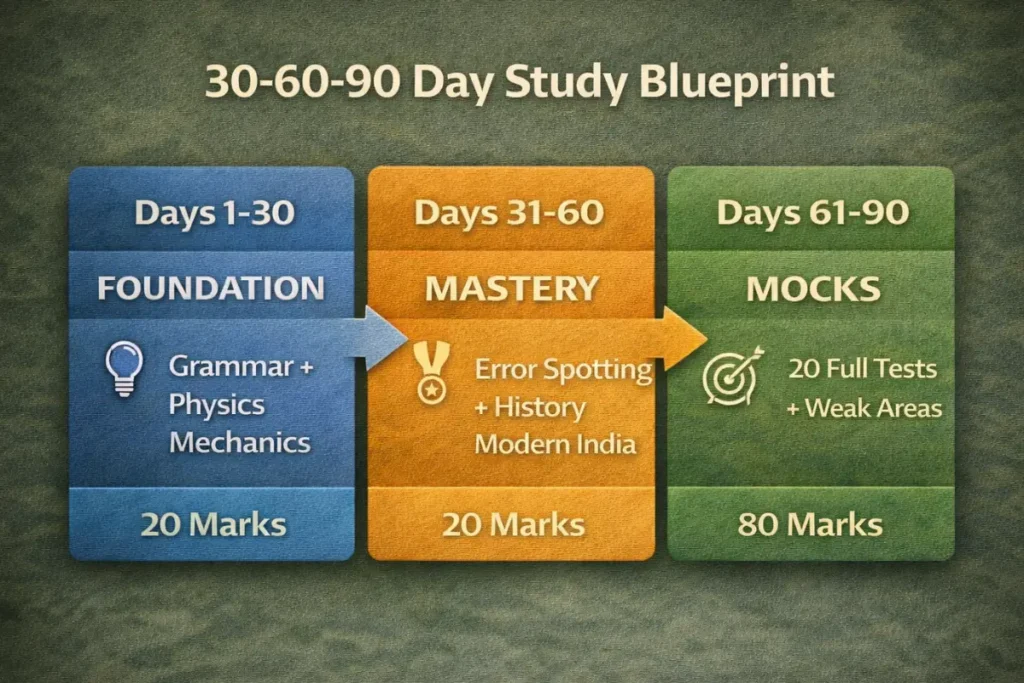
Days 1–30: Foundation Building
Focus: Grammar fundamentals, history timeline, basic GK concepts
Daily schedule:
- Morning (45 min): Grammar + vocabulary (NCERT Class 10 English)
- Afternoon (60 min): Physics mechanics (numericals)
- Evening (45 min): History timeline creation + 1 current affairs topic
- Night (30 min): Flashcard review
Milestones:
- Complete NCERT grammar chapters (tenses, articles, subject-verb agreement)
- Memorise 300 vocabulary words (using the Anki app)
- Create a history timeline: 2000 BCE to 1950 CE with 50 landmark events
- Track 30 current affairs events (1 per day)
Days 31–60: Concept Mastery
Focus: Advanced grammar, error spotting, physics, thermodynamics, chemistry, oxidation-reduction, history, medieval period
Daily schedule:
- Morning (60 min): Error spotting + comprehension (1 passage)
- Afternoon (75 min): Chemistry + General Science (alternate days)
- Evening (60 min): Geography map reading + history of modern India
- Night (30 min): Current affairs + revision
Milestones:
- Solve 200 error-spotting questions (identify all patterns)
- Read 15 comprehension passages (targeting 4-minute speed per passage)
- Complete chemistry chapters (periodic table, bonding, redox)
- Finalise map reading skills (10 map-marking questions daily)
Days 61–90: Refinement & Mock Tests
Focus: Full-length mock tests, time management, and weak area bolstering
Daily schedule:
- Morning (90 min): Full mock test (200-question GAT paper)
- Afternoon (45 min): Review mock test, identify error patterns
- Evening (45 min): Targeted weak area practice (grammar, GK, comprehension)
- Night (30 min): Current affairs + previous day’s review
Milestones:
- Complete 20 full mocks (achieve 500+ marks in 3 consecutive mocks)
- Master all error patterns (zero mistakes on familiar error types)
- Current affairs updated to the latest month
- Speed optimisation (solve full GAT in 165 minutes with 90%+ accuracy)
Study Intensity Warning: This is aggressive but doable. Adjust based on your baseline—if you’re starting from scratch, add 30 days.
Common Mistakes to AVOID (Learn from 10,000+ Aspirants’ Failures)
| Mistake | Why It Kills Your Score | Solution |
|---|---|---|
| Ignoring comprehension (easy-looking, so skipped) | Comprehension is 20 marks of 200—skipping it = a certain 100-mark loss | Dedicate 20 min daily to 1 passage |
| Memorizing grammar rules without practice | Neglecting historical dates & causation | After every rule, solve 10 practice questions immediately |
| Studying physics without numericals | Conceptual understanding remains abstract; questions ask for calculations | 70% of study time = numericals; 30% = theory |
| Memorising grammar rules without practice | Memorized dates without understanding = 50% marks lost | Stick to the top 500 high-frequency words |
| Starting current affairs too late | Narrate, don’t memorise; link events chronologically | Start current affairs tracking from Day 1 of prep |
| Overloading vocabulary with obscure words | NDA tests practical vocabulary, not SAT-level obscurity | Current affairs seem easy until you realise “which year was that protest?” |
| Inconsistent mock test practice | Skipping mocks means facing time management shocks on exam day | Minimum 1 full mock every 3 days after Day 60 |
| Ignoring map reading under time pressure | Memorising grammar rules without practice | Start geography mapping from Day 1 |
Free Resources & Tools (Download Your Study Arsenal)
Essential Resources List:
- NCERT textbooks (Classes 10–12): English Communicative, History, Geography, Science
- Competitive exam primers: Wren & Martin (grammar), Objective General Knowledge (Lucent or Arihant)
- YouTube channels: Khan Academy, Amoeba Sisters (science), StudyIQ (GK)
- Mobile apps: Anki (flashcards), Testbook (mock tests), Mrunal.org (current affairs)
- Websites: PIB, ISRO, ThePrint, Drishti IAS
Download FREE: ‘NDA GK Daily Dose’ PDF – Coming Soon
30 high-frequency GK topics × 5 facts each = 150 quick daily reads. Perfect for last-week revision, morning quick-reads, or travel time prep. [Available on NDA Study website]
Pro Tips from NDA Toppers: Beat 95% of Aspirants
1. The 80/20 Rule
“80% of NDA GAT questions come from 20% of your study material. Find that 20% (high-frequency topics) and master it obsessively.” This means physics, mechanics, history, the independence movement, and geography map reading deserve disproportionate focus.
2. Dual-Tracking Beats Sequential
“Study 2–3 subjects simultaneously, not one after another. Your brain retains better with context switching.” Alternating between English, physics, and history prevents boredom and builds retention through spaced repetition.
3. Speed ≠ Accuracy
“In your first 60 days, ignore timers. Build accuracy first (get questions right), then optimise speed (weeks 61–90).” A slow, accurate approach beats a fast, careless one every single time.
4. The ‘Teach-Back’ Method
“After studying a topic, explain it to an imaginary student without notes. If you can’t, your understanding has gaps.” This forces deep processing and reveals conceptual weaknesses immediately.
5. Current Affairs Isn’t Optional
“I scored 38/40 in current affairs because I started tracking events from Day 1. Most aspirants start 2 weeks before the exam—too late.” Systematic tracking beats cramming.
6. Mock Tests Reveal Truth
“Your first mock reveals your starting score. After that, mock scores tell you if you’re on track. Take them seriously.” Treat mocks as diagnostic tools, not just practice.
FAQs | NDA GAT syllabus 2026
1. What’s the difference between NDA GAT and the Mathematics portion?
GAT covers only English (200) + General Knowledge (400) = 600 marks total. Mathematics is a separate 120-mark paper. Candidates must prepare for both independently.
2. How much time should I allocate to each subject during 90-day prep?
Physics (25 hours), History (20 hours), Geography (20 hours), Chemistry (12 hours), General Science (8 hours), English (35 hours), Current Affairs (10 hours). Total: 130 hours over 90 days = ~90 minutes daily.
3. Are the past 10 years’ NDA GAT papers enough for practice?
They’re essential but not sufficient. Use papers for pattern recognition, then supplement with topic-wise competitive exam resources (Arihant, Lucent) for deeper practice.
4. How important is current affairs for NDA GAT?
It’s 40 marks (6.7% of GAT), but high scorers use it to distinguish themselves. Events from January 2024–December 2026 are “safe zones”; older events rarely appear.
5. Can I crack GAT in 2 months?
Possible if you’re starting with basics and aiming for 400 marks, but 500+ requires 3+ months. Quality matters more than speed. Consistency beats intensity.
6. Is Hindi-medium study possible for NDA GAT?
English section requires English medium, so no. Geography & history NCERT are available in Hindi, but competitive exam resources are primarily English. Bilingual prep is ideal.
7. What’s the passing score for NDA GAT?
There’s no official “passing” score. Qualifying for NDA depends on your merit rank among ~400,000 aspirants. Aiming for 500+/600 puts you in the top 10%.
8. Which books are best for NDA GAT preparation?
NCERT (Classes 10–12), Wren & Martin Grammar Guide (selective chapters), Lucent’s Objective General Knowledge, Arihant competitive exam series. Avoid books claiming “complete syllabus”—no single book covers all nuances.
Your Path to 500+ Marks
The NDA GAT syllabus 2026 is vast but highly structured. By following this roadmap—mastering English comprehension first, building GK systematically (physics, history, geography), tracking current affairs daily, and practising consistently—you’ll crack the top 10%. The secret? Start early, study smart (not hard), and don’t skip weak areas.
Your competition isn’t the syllabus; it’s yourself. Consistency for 90 days beats intensity for 30 days. Begin with Week 1 of the study plan above. Track your progress. Share your wins in the comments—let’s build an NDA community that wins together.
Updated for 2026 exam pattern | Exam pattern stability confirmed for 2026–2027


![Is Mathematics Compulsory for NDA? Arts/Commerce Students Must Read This [EXCLUSIVE ]](https://ndastudy.com/wp-content/uploads/2025/12/Is-Mathematics-Compulsory-for-NDA-300x169.webp "Is Mathematics Compulsory for NDA? Arts/Commerce Students Must Read This [EXCLUSIVE ] 7")