Bharat Forge Limited, a global technology and engineering company, has announced a major step forward for the Indian Navy. They are developing a fully indigenous naval propulsion system, which is an important achievement for India’s defense industry. Baba Kalyani, the Chairman and Managing Director of Bharat Forge, confirmed this shift towards making advanced naval systems.
The new propulsion system will include all key parts made in India. This includes the propeller shaft, main gearbox, controllable pitch propeller, and electronic pitch control system. This development is significant because India has typically depended on foreign suppliers for propulsion systems.
Addressing India’s Maritime Manufacturing Gap
India’s naval modernization currently faces a critical component dependency. While indigenous naval vessel construction achieves 95 percent domestic content in hull structures, propulsion systems—the mechanical backbone of any warship—remain only 60-65 percent indigenized. Bharat Forge’s project directly addresses this vulnerability by developing a complete indigenous propulsion ecosystem.
“This initiative demonstrates that India’s private sector can compete with global defense manufacturers in technologically demanding domains,”
Baba Kalyani, The Chairman and Managing Director of Bharat Forge
“This initiative reflects our commitment to achieving technological independence in defense sectors where India has historically depended on foreign suppliers,” Kalyani stated. “Naval propulsion represents one of the most technically demanding components in warship design, requiring precision engineering, advanced metallurgy, and sophisticated electronic control systems.”
The project is being executed in close collaboration with the Indian Navy, whose technical expertise and operational requirements guide development priorities. The Navy’s involvement ensures that the propulsion system meets exacting operational standards essential for sustained naval operations across varying sea conditions and deployment scenarios.
Technical Complexity and Engineering Excellence
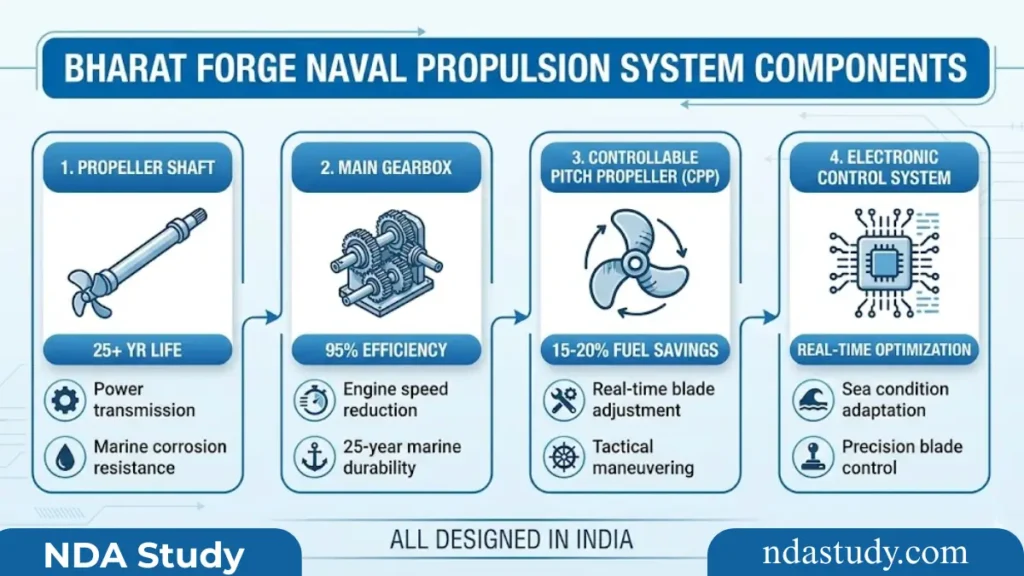
Naval propulsion systems demand exceptional technical capabilities. Each component serves critical functions:
- The propeller shaft transmits engine power to the propeller while resisting corrosion and dynamic stress across 20-30 year operational lifespans. Advanced steel metallurgy and precision manufacturing ensure optimal performance.
- The main gearbox reduces engine speed while maintaining mechanical efficiency above 95 percent, a requirement for sustained naval operations. Modern naval gearboxes represent complex mechanical and metallurgical achievements, historically supplied only by specialized European manufacturers.
- The controllable pitch propeller (CPP) enables variable blade-angle adjustments in real-time, allowing vessels to change speed without engine shutdown—critical for tactical maneuvering and fuel efficiency. CPP technology offers 15-20 percent fuel efficiency improvements compared to fixed-pitch alternatives.
- The electronic pitch control system coordinates all propeller adjustments through integrated sensors and hydraulic systems, optimizing performance across varying operational conditions, including different water temperatures, salinity levels, and vessel loading scenarios.
Strategic Significance for Indian Navy Modernization
India’s naval expansion plans require the addition of 60 new warships over the next decade, with over 60 vessels currently under construction. This expedited(Fast) shipbuilding program, valued at approximately ₹2.35 lakh crore, necessitates reliable domestically sourced propulsion systems to adhere to project timelines and minimize foreign exchange expenses. Bharat Forge’s indigenous propulsion system plays a crucial role in supporting this modernization initiative by:
Eliminating dependency on foreign suppliers for propulsion systems in the supply chain can reduce procurement timelines by 12 to 18 months for new naval construction projects.This approach enables operational autonomy, allowing Indian shipyards to maintain complete control over all critical maritime systems without needing foreign technical support. Additionally, using domestically manufactured components can lower overall costs for naval platforms, which in turn frees up defense budget allocations for acquiring more platforms or advancing sensor systems.
Company Track Record in Defense Manufacturing
Bharat Forge has shown it can handle complex naval projects with recent successes. In December 2025, the company signed a contract worth ₹1,661.9 crore to supply 255,128 Indian-made Close Quarter Battle (CQB) carbines. This contract confirms their ability to fulfill large government defense orders.
Currently, Bharat Forge has a defense order book of about ₹10,000 crore, and it expects this to grow to ₹12,000-14,000 crore by the end of fiscal year 2026. This visibility in orders gives the company financial stability for long-term research and development needed for naval propulsion. Bharat Forge also operates through Kalyani Strategic Systems Limited (KSSL), its defense-focused subsidiary, which has ₹155.5 million in active export defense orders. This highlights the company’s readiness for export and compliance with international quality standards.
Export Market Opportunity
Beyond domestic Navy requirements, Bharat Forge’s indigenous propulsion technology presents significant export market potential. India’s defense exports reached ₹23,622 crore in fiscal year 2025, representing 34 percent year-over-year growth, with naval platforms representing the highest-value export segment. Friendly nations in the Indian Ocean Region increasingly seek cost-effective naval propulsion solutions as alternatives to European suppliers facing manufacturing constraints.
Strategic Export Markets:

Under India's SAGAR doctrine (Security and Growth for All in the Region), friendly nations in the Indian Ocean Region increasingly seek naval platforms equipped with cost-effective propulsion systems:

  1. Vietnam: Building offshore patrol vessel fleet; actively evaluates Indian propulsion solutions

  2. Philippines: ₹375 million precedent for Indian defense equipment (BrahMos missiles, 2022)

  3. Mauritius, Sri Lanka: Indian-supplied OPVs and patrol boats seeking indigenous propulsion upgrades

  4. Middle East & African Nations: Growing appetite for Indian defense platforms as Europe faces capacity constraints
Indian propulsion systems offer 30-40 percent cost advantages compared to Western alternatives while maintaining equivalent technical performance. Realistic export projections suggest ₹5,000-10,000 crore in propulsion system export orders by 2030, as allied nations validate the technology through Indian Navy operational deployment and certification.
Development Timeline and Milestones
Bharat Forge’s propulsion development timeline aligns with the Indian Navy’s modernization schedules:
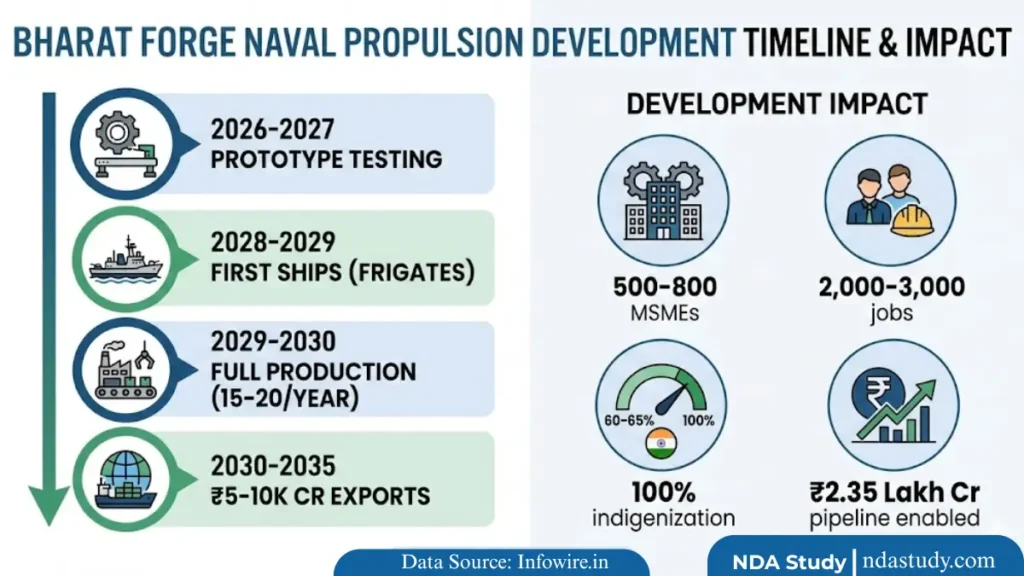
- 2026-2027: Prototype development, component testing, and design validation against Navy operational requirements. DRDO partnership programs advance in parallel.
- 2028-2029: Initial production batches integrate into new-build naval vessels, typically Guided Missile Frigates or Next Generation Corvettes. In-service testing and performance validation commence.
- 2029-2030: Full-rate production supporting 15-20+ annual naval ship inductions. Supply chain scaling and MSME capacity expansion accelerate.
- 2030-2035: Export qualification and foreign naval adoption by allied nations.
Broader Ecosystem Development
Bharat Forge’s propulsion initiative is helping to expand the broader defense manufacturing ecosystem. Manufacturing components for naval propulsion requires precise contributions from 500 to 800 small and medium enterprises (SMEs) in fields such as metallurgy, precision machining, electronics, and specialized testing, which creates significant industrial opportunities.
Also Know:
- NDA GAT Syllabus 2026: Complete English + GK Guide to 600 Marks Success
- NDA Mathematics Syllabus 2026: Complete Topics Breakdown & Weightage
- Is Mathematics Compulsory for NDA? Arts/Commerce Students Must Read This
- NDA Exam Pattern 2026: Complete Changes, New Strategy & How to Crack It
This project is expected to generate demand for 2,000 to 3,000 specialized technicians in naval engineering, precision manufacturing, and electronic systems, fostering technical skills development throughout India’s manufacturing sector. Current government policy reserves 75 percent of all defense procurement for domestic suppliers, creating a favorable environment for the MSME ecosystem and supporting Bharat Forge’s supply chain.
FAQs | Bharat Forge Develops Fully Indigenous Naval Propulsion System for Indian Navy
1. What is Bharat Forge developing for the Indian Navy?
Bharat Forge is developing a fully indigenous naval propulsion system comprising a propeller shaft, a main gearbox, a controllable pitch propeller (CPP), and a pitch control electronic system. All components are designed and manufactured domestically, eliminating foreign supplier dependency
2. Why is naval propulsion development significant for India?
Propulsion systems represent India’s weakest indigenization link at 60-65% (vs 95% for hulls). Bharat Forge’s project addresses this critical gap, enabling complete operational autonomy for India’s ₹2.35 lakh crore naval modernization pipeline and 60+ warships under construction.
3. What are the key components of Bharat Forge’s propulsion system?
The system includes four critical components:
1. Propeller shaft: Transmits engine power, resists 25+ year marine corrosion
2. Main gearbox: Achieves 95%+ efficiency, reduces engine speed for the propeller
3. Controllable pitch propeller (CPP): Enables real-time blade angle adjustment for 15-20% fuel savings & tactical maneuvering
4. Electronic control system: Optimizes performance across sea conditions
4. What are the propulsion export opportunities for Bharat Forge?
₹5-10,000 crore by 2030. India’s defense exports hit ₹23,622 crore FY25 (+34% YoY). Propulsion offers a 30-40% cost advantage vs Europe. Targets: Vietnam, Philippines, Indian Ocean allies under the SAGAR doctrine.
5. Can Bharat Forge deliver after the ₹1,661.9 crore carbine success?
Yes. Bharat Forge executed India’s largest small arms deal (255,128 CQB carbines, Dec 2025). Defense order book: ₹10,000 crore (target ₹14,000 crore FY26). KSSL subsidiary has ₹155.5M export orders proving naval capability.
6. When will Bharat Forge propulsion be in Indian Navy ships?
2026-27: Prototype testing
2028-29: First warships (frigates/corvettes)
2029-30: Full production (15-20 ships/year)
2030+: Export-ready. Supports the Navy’s 175-200 ship target by 2035.
7. Why is naval propulsion India’s biggest defense manufacturing gap?
India achieves 95% indigenization for hulls but only 60-65% for propulsion systems – the mechanical heart of warships. Bharat Forge closes this gap, enabling ₹2.35 lakh crore naval modernization for 60+ warships under construction.
Alignment with National Defense Strategy
The project directly supports India’s Atmanirbhar Bharat (Self-Reliant India) initiative for defense manufacturing. By developing indigenous propulsion capabilities, India can reduce its foreign exchange expenditure on naval imports while also building its own technological expertise. The development of propulsion systems represents the last technical barrier to fully indigenous naval platform manufacturing. Once this capability is established, India will gain complete operational control over its maritime defense assets, which is a strategic objective central to India’s security posture in the Indo-Pacific region.
“This initiative shows that India’s private sector can compete with global defense manufacturers in demanding technological fields,” Kalyani stated. “Developing naval propulsion is not just a procurement decision; it signifies India’s dedication to technological independence in defense capabilities.”