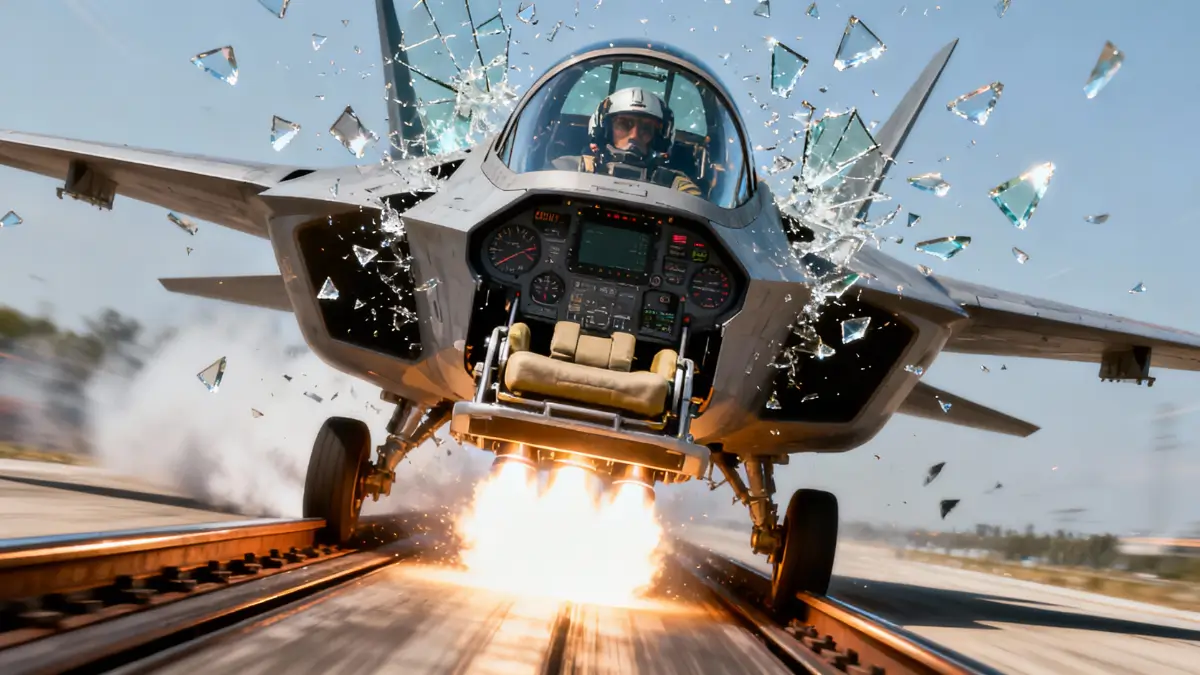
Imagine sitting in a cockpit, hurtling down a track at 800 kilometers per hour. The world outside is a blur of concrete and steel. Suddenly, an explosion rips the glass canopy above your head to shreds. In less than the blink of an eye—literally, a fraction of a second—a rocket motor under your seat ignites, blasting you clear of the fuselage with a force of 18Gs.
This isn’t a scene from Top Gun. It is the reality of what happened on December 2, 2025, at a secretive facility in Chandigarh.
In a historic achievement that has sent ripples through the global aerospace community, the Defence Research and Development Organisation (DRDO) successfully conducted a high-speed rocket-sled test of India’s first fully indigenous Crew Escape System. By validating this technology at combat-relevant speeds, India hasn’t just tested a seat; it has smashed a decades-old technology monopoly held by a handful of global superpowers.
Here is the full story of the test that put India in the “Elite Club,” the incredible engineering behind it, and why this changes the game for the Indian Air Force forever.
The Event: 800 km/h on the “Tracks of Doom”
The test took place at the Terminal Ballistics Research Laboratory (TBRL) in Chandigarh, home to one of the most unique engineering marvels in Asia: the Rail Track Rocket Sled (RTRS).
While most people think aircraft testing happens in the sky, the most dangerous tests happen on the ground. To certify an ejection seat, you cannot simply put a pilot in a plane and ask them to eject; the risk is astronomical. Instead, engineers use the RTRS—a 4-kilometer-long set of precision rail tracks.
The Setup:
Engineers mounted the entire front fuselage (the cockpit section) of a LCA Tejas fighter jet onto a specialized heavy-duty sled. This sled was strapped to a cluster of high-powered solid rocket boosters.
The Execution:
- Ignition: The rockets fired, accelerating the sled from a standstill to 800 km/h in mere seconds.
- The Trigger: As the sled hit the target velocity (simulating a high-speed low-level flight profile), the onboard computer triggered the ejection sequence.
- The “Bang”: A precise pyrotechnic charge detonated the cockpit canopy, severing the glass instantly to clear a path.
- The Exit: The indigenous ejection seat fired, launching the test dummy (instrumented with hundreds of sensors) clear of the rushing tail fin.
- The Recovery: Drogue parachutes deployed to stabilize the tumbling seat, followed by the main chutes, bringing the dummy to a safe, controlled landing.
The result? Mission Accomplished. All parameters were green. The dummy survived. The sequencing was flawless.
Why This Is a “Big Deal”: Breaking the Elite Club
To understand the magnitude of this success, you have to look at the global map of aerospace technology. Building a fighter jet is hard. Building a seat that can save a pilot from a burning, spinning jet at supersonic speeds is, in some ways, even harder.
Until this week, only five nations possessed the end-to-end technology to design, manufacture, and certify fighter ejection systems:
- United Kingdom (Martin-Baker)
- United States (Collins Aerospace)
- Russia (NPP Zvezda)
- France (Safran/Martin-Baker Joint Ventures)
- China (HTY Industry)
For decades, the world (including India) has relied almost exclusively on Martin-Baker, the British giant whose seats are the gold standard. Every Tejas Mk1 currently flying uses a Martin-Baker seat.
The Dependency Problem:
Relying on foreign seats creates a strategic choke point.
- Export Controls: If India wants to sell the Tejas to a country the UK doesn’t like (e.g., the recent case with Argentina), the UK can simply veto the sale of the ejection seats, effectively grounding the deal.
- Supply Chain Shocks: In times of war, if supply lines are cut, grounding jets because of a lack of pyrotechnic cartridges for the seats is a disaster.
With the December 2 test, India has declared independence. We now own the IP (Intellectual Property), the manufacturing, and the testing infrastructure. The Tejas Mk2 and the 5th-generation AMCA (Advanced Medium Combat Aircraft) will no longer be tethered to foreign suppliers for pilot safety.
Also Read:
INS Aridhaman Submarine Commissioning 2025: India’s Third SSBN Transforms Strategic Deterrence
K-4 SLBM specifications: India’s Submarine-Launched Ballistic Missile Explained
India’s Mach 10 “Carrier Killer” LR-AShM: The Hypersonic Missile That Changes Everything in 2025
The Science of Survival: The “Chain of Escape”
Ejecting at 800 km/h is a violent, chaotic event. The air pressure at that speed is like getting hit by a wall of solid water. If the seat fires 0.1 seconds too early or too late, the pilot could impact the aircraft’s tail fin or suffer fatal G-force injuries.
The indigenous system developed by DRDO, HAL (Hindustan Aeronautics Limited), and ADA (Aeronautical Development Agency) relies on a complex “sequencing logic” that executes faster than human thought.
Step 1: Canopy Severance (0.00 Seconds)
When the pilot pulls the handle, the system doesn’t wait for the glass canopy to blow off in the wind. It cuts it. A Miniature Detonating Cord (MDC) embedded in the glass explodes, shattering the canopy into millions of harmless fragments instantly. This was a key validation point of the December 2 test.
Step 2: The Catapult (0.20 Seconds)
A telescopic tube under the seat fires (using gas pressure), pushing the pilot up and out of the cockpit. This initial “kick” ensures the pilot clears the instrument panel without crushing their legs.
Step 3: The Rocket Motor (0.40 Seconds)
Once clear of the rails, the under-seat rocket motor ignites. This provides the sustained thrust needed to vault the pilot high above the aircraft’s tail fin. At 800 km/h, the wind blast is trying to push the pilot backward into the tail; the rocket must fight this force.
Step 4: Stabilization (0.60 Seconds)
A tumbling seat is lethal. It can snap a spine. The system deploys a small “drogue parachute” immediately to stabilize the seat and align it into a feet-down position.
Step 5: Recovery (1.50+ Seconds)
The main parachute deploys. The seat separates from the pilot (so they don’t land sitting in a heavy metal chair), and the pilot drifts down.
Validating this entire chaotic dance at 800 km/h is a testament to the precision of Indian coding, pyrotechnics, and aerodynamics.
The Hero Behind the Scene: TBRL’s RTRS Facility
We need to talk about the track itself. The Terminal Ballistics Research Laboratory (TBRL) in Chandigarh is one of DRDO’s unsung heroes.
The RTRS (Rail Track Rocket Sled) is a 4-kilometer-long, perfectly straight railway track. But unlike a train track, these rails are aligned with laser precision to handle speeds exceeding Mach 1 (supersonic).
- Why not flight test? Testing an unproven ejection seat in flight would require a pilot to fly a plane and then bail out—risking both the pilot and a multimillion-dollar aircraft.
- The Sled Solution: The rocket sled allows engineers to push the system to the “edge of the envelope” without risking a single human life. They can simulate crosswinds, different angles of attack, and varying speeds simply by adjusting the rocket boosters.
The December 2 test at 800 km/h was a “High Subsonic” test. This is often considered the most dangerous regime for ejection because the aerodynamic drag is massive, but you don’t yet have the “clean” shockwaves of supersonic flight. It is the turbulent, violent zone where systems often fail. DRDO’s system didn’t flinch.
What This Means for the Tejas Mk2 and AMCA
This breakthrough is the backbone of India’s future air power.
1. The Tejas Mk1A and Mk2
As India ramps up production of the Tejas Mk1A and designs the larger, more powerful Mk2, the goal is to increase “indigenization content.” Every part made in India drives down cost and increases availability. Replacing a £200,000+ British seat with an Indian one saves millions over the fleet’s life.
2. The AMCA (Advanced Medium Combat Aircraft)
India is building its own 5th-generation stealth fighter. Stealth aircraft have unique canopy designs (often coated with gold or indium tin oxide for radar deflection). You cannot just buy an off-the-shelf seat for a stealth jet; the escape system must be integrated into the stealth profile. Having in-house ejection tech is a prerequisite for building a true 5th-gen fighter.
3. Export Freedom
The “Argentina Case” is the perfect example. Argentina wanted to buy the Tejas. The deal stalled because the UK (which supplies the current seats) has an arms embargo on Argentina dating back to the Falklands War. With this new Indian seat, New Delhi can offer the Tejas to anyone, anywhere, without asking for London’s permission.
The Human Element: “We Got Your Back”
At the end of the day, this technology is about one thing: Trust.
When a young Flight Lieutenant climbs into a Tejas for a dawn patrol, they are trusting that machine with their life. If the engine fails, if a bird strikes, or if a missile hits, they have one final option. They reach down, grab the black-and-yellow handle, and pull.
In that split second, they are betting everything on the engineering beneath them. Until now, that trust was placed in British engineers. From today onwards, that trust is placed in Indian scientists, Indian code, and Indian manufacturing.
The December 2 test proved that if the worst happens at 800 km/h, the Indian system works. It separates the canopy. It clears the tail. It opens the chute. It brings the warrior home.
A Milestone for “Atmanirbhar Bharat”
The successful high-speed qualification of the crew escape system is more than a headline; it is a graduation ceremony for the Indian aerospace industry. We have moved from “assembling” to “creating,” from “buying” to “building,” and from “following” to “leading.”
As the dust settles on the tracks at TBRL Chandigarh, one thing is clear: The Indian sky is safer today than it was yesterday, and it’s protected by Indian ingenuity.
Share this story if you’re proud of this massive leap in Indian Defence Technology! 🇮🇳
![Bharat Forge Develops Fully Indigenous Naval Propulsion System for Indian Navy [Explained]](https://ndastudy.com/wp-content/uploads/2026/01/Bharat-Forge-Develops-Fully-Indigenous-Naval-Propulsion-System-for-Indian-Navy-300x169.webp "Bharat Forge Develops Fully Indigenous Naval Propulsion System for Indian Navy [Explained] 2")