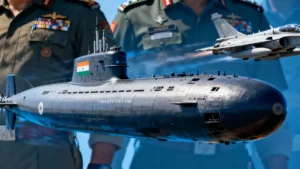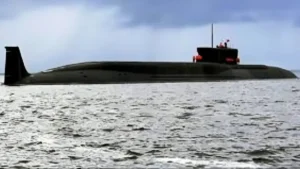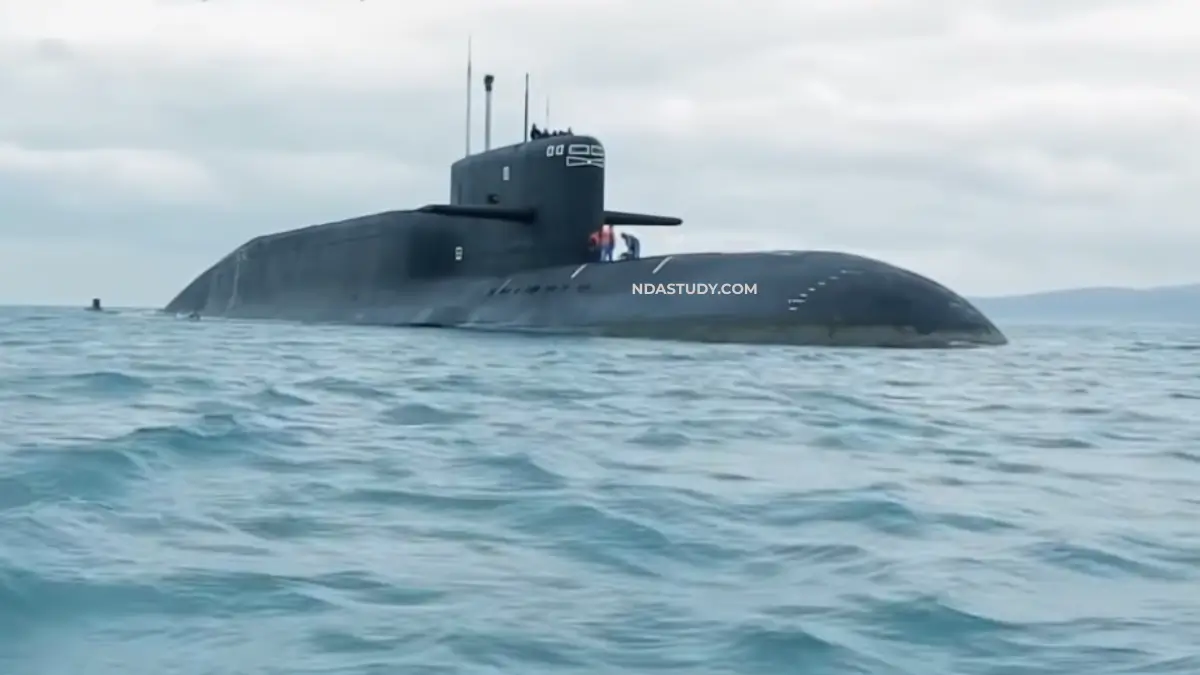
India is approaching a historic military milestone. Navy Chief Admiral Dinesh K. Tripathi announced on December 2, 2025, that INS Aridhaman submarine commissioning 2025 is imminent, with the third Arihant-class SSBN expected to enter service around 2026–2027. This breakthrough represents more than just another warship—it fundamentally transforms India’s nuclear deterrent from theoretical to practically credible, enabling 24/7 at-sea deterrence for the first time.
What Is INS Aridhaman? India’s Third SSBN Explained
INS Aridhaman, officially designated S4/SSBN 82, represents India’s most advanced nuclear-powered ballistic missile submarine. Quietly launched in November 2021 at Visakhapatnam’s Ship Building Centre, Aridhaman showcases India’s mastery over complex naval nuclear propulsion—technology once exclusive to five permanent Security Council members plus India.
Quick Facts About Aridhaman:
- Official Designation: INS Aridhaman (S4/SSBN 82)
- Class: Arihant-class nuclear submarine
- Builder: Ship Building Centre (SBC), Visakhapatnam
- Quietly Launched: November 2021
- Expected Commissioning: 2026–2027
- Command: Strategic Forces Command
- Indigenous Content: Approximately 90% (India’s highest SSBN)
Understanding SSBN Technology
SSBN stands for “Ship Submersible Ballistic Nuclear.” Unlike conventional diesel-electric submarines that must surface regularly, SSBNs use nuclear reactors providing virtually unlimited underwater endurance. This fundamental difference makes all the difference in strategic deterrence.
| Submarine Type | Mission | Weapons | Max Speed | Range | India’s Fleet |
|---|---|---|---|---|---|
| SSBN (Ballistic) | Nuclear second-strike deterrence | Nuclear missiles (K-4, K-15) | 24 knots | Unlimited | Arihant, Arighaat, Aridhaman |
| SSN (Attack) | Anti-ship and anti-submarine warfare | Torpedoes, cruise missiles | 24+ knots | Unlimited | INS Chakra (leased) |
| Diesel-Electric | Conventional naval operations | Torpedoes, anti-ship missiles | 20 knots max | 5,000 km | Kalvari, Khanderi class |
Why SSBN matters: An SSBN’s location is always unknown. An enemy cannot launch a pre-emptive strike against a target it cannot locate. This invisibility makes SSBN deterrence absolutely credible—the foundation of nuclear stability.
INS Aridhaman Specifications: Technical Breakthrough
INS Aridhaman submarine commissioning 2025 marks a significant technological leap. The submarine incorporates three major upgrades compared to its predecessors:
Physical Characteristics and Dimensions
| Specification | INS Aridhaman | INS Arighaat | INS Arihant | Key Difference |
|---|---|---|---|---|
| Surface Displacement | 6,000 tonnes | 6,000 tonnes | 6,000 tonnes | Similar footprint |
| Submerged Displacement | 7,000 tonnes | 6,000 tonnes | 6,000 tonnes | Aridhaman heavier |
| Length | ~111.6 meters | ~111 meters | ~111 meters | Compact design |
| Hull Diameter | ~11 meters | ~11 meters | ~11 meters | Standard width |
| Crew | 95–100 | 95–100 | 95–100 | Same manning |
| Max Submerged Speed | 24 knots | 24 knots | 24 knots | Performance identical |
| Operational Range | Unlimited (nuclear) | Unlimited | Unlimited | Months underwater |
| Indigenous Content | ~90% | ~70% | ~65% | Self-reliance leap |
The Revolutionary 8-Tube Launch System
Aridhaman’s most significant upgrade: eight vertical launch system (VLS) tubes instead of the four on Arihant and Arighaat. This 100% capacity increase enables three deployment configurations:
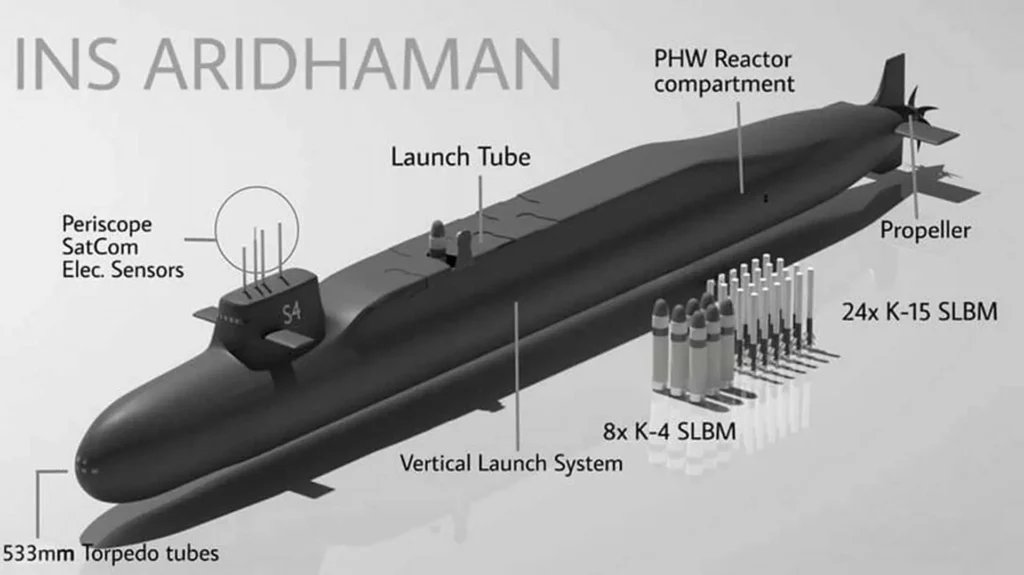
Configuration 1: K-4 Primary Load
- 8 K-4 missiles at 3,500 km range each
- Transcontinental reach from Bay of Bengal
- Covers entire Indo-Pacific region
Configuration 2: K-15 Alternative Load
- 24 K-15 Sagarika missiles at 750 km range
- Regional coverage with maximum salvo volume
- Backup deterrent option
Configuration 3: Mixed Load
- Combination of K-4 and K-15 missiles
- Flexible deterrent posture
- Response to varying threat scenarios
What This Means: Aridhaman carries twice the firepower of Arihant per patrol, multiplying India’s strategic deterrent capability dramatically.
Reactor and Propulsion System
The submarine’s 83 MW Compact Light Water Reactor (CLWR-B1), developed by Bhabha Atomic Research Centre (BARC), represents significant indigenous advancement. The reactor provides several critical advantages:
- Near-infinite underwater endurance (months, limited only by supplies)
- Quieter operation compared to earlier generations
- Enhanced efficiency reducing thermal signature
- Deeper diving capability improving stealth
- Improved reliability from indigenous design refinement
A nuclear reactor, unlike diesel engines, requires no air intake. Aridhaman can remain submerged indefinitely—a capability revolutionary for submarine deterrence.
Stealth Technology Integration
Aridhaman incorporates advanced stealth measures making detection extraordinarily difficult:
Hull and Materials
- Low-carbon steel with specialized composition
- Anechoic tiles absorbing sonar returns
- Smooth hull contours reducing acoustic reflection
Sonar and Sensing
- Indigenous sonar systems (bow array, flank arrays)
- Towed array hydrophones for extended detection
- Advanced fire-control computers
- Indigenous navigation systems
Strategic Implication: A submarine that cannot be reliably detected cannot be pre-emptively targeted. This survivability guarantee is what makes deterrence truly credible.
Why INS Aridhaman Submarine Commissioning 2025 Transforms India’s Nuclear Doctrine
The INS Aridhaman commissioning in 2025 strengthens India’s nuclear triad, profoundly impacting its deterrence doctrine and strategic posture.
Completing the Nuclear Triad
India’s strategic deterrent spreads nuclear capability across three independent platforms—the nuclear triad. This distribution ensures no single strike can eliminate retaliation capability.
India’s Three-Pillar Strategic Deterrent:
Land-Based Deterrent (Agni Missiles)
- Agni-I: 700 km range
- Agni-II: 2,000 km range
- Agni-III: 3,500 km range
- Agni-IV: 4,000 km range
- Agni-V: 5,000 km range
- Agni-VI: 6,000+ km range
- Command: Indian Army
- Status: Fully operational since late 1990s
Air-Based Deterrent (Aircraft-Delivered Weapons)
- Platforms: Mirage 2000H, Sukhoi Su-30MKI, future HAL Tejas
- Command: Indian Air Force
- Status: Operational since 2009
Sea-Based Deterrent (SSBN-Launched Missiles) ← ARIDHAMAN’S ROLE
- Platforms: Arihant-class SSBNs
- Missiles: K-15 (750 km), K-4 (3,500 km)
- Command: Strategic Forces Command
- Status: Transitioning from nascent to fully credible with Aridhaman
The “Three SSBNs Simultaneously” Strategic Breakthrough
Current situation presents a vulnerability. With only two operational SSBNs (Arihant and Arighaat), India struggles to maintain one submarine on continuous deterrence patrol. Aridhaman changes this fundamental calculus.
Before Aridhaman (Current Scenario):
- India can maintain ZERO to ONE submarine on deterrence patrol at any moment
- Maintenance, refit, crew rotation leave gaps in coverage
- Enemy might miscalculate: “India’s deterrent is not continuous”
- Strategic vulnerability: temporal window of insufficient deterrence
After Aridhaman (2026–2027 Onward):
- India guarantees ONE submarine always on deterrence patrol (location unknown)
- Two other submarines: one undergoing maintenance, one in training/preparation
- Enemy faces real, unknowable threat at all times
- Strategic certainty: 24/7 retaliation capability guaranteed
The Transformation: From theoretical deterrent to practical guarantee. This single capability shift—continuous at-sea deterrence—elevates India from emerging to established nuclear power. It joins India with USA, Russia, France, and UK in this exclusive club.
How No-First-Use Doctrine Is Strengthened
India has pledged “No-First-Use” (NFU) of nuclear weapons since 1999. This doctrine distinguishes India from other nuclear powers and anchors regional stability. Aridhaman makes this pledge credible:
NFU Logic:
- A nation with continuous at-sea deterrence doesn’t need to launch first
- Can absorb massive nuclear attack and still retaliate devastatingly
- This confidence allows maintaining high NFU credibility
- Paradoxically, invulnerable deterrent strengthens peace
India’s NFU doctrine becomes more believable, not less, with Aridhaman’s commissioning. India can afford to be peaceful because its deterrent cannot be eliminated.
INS Aridhaman vs. INS Arihant: Evolution of India’s SSBN Fleet
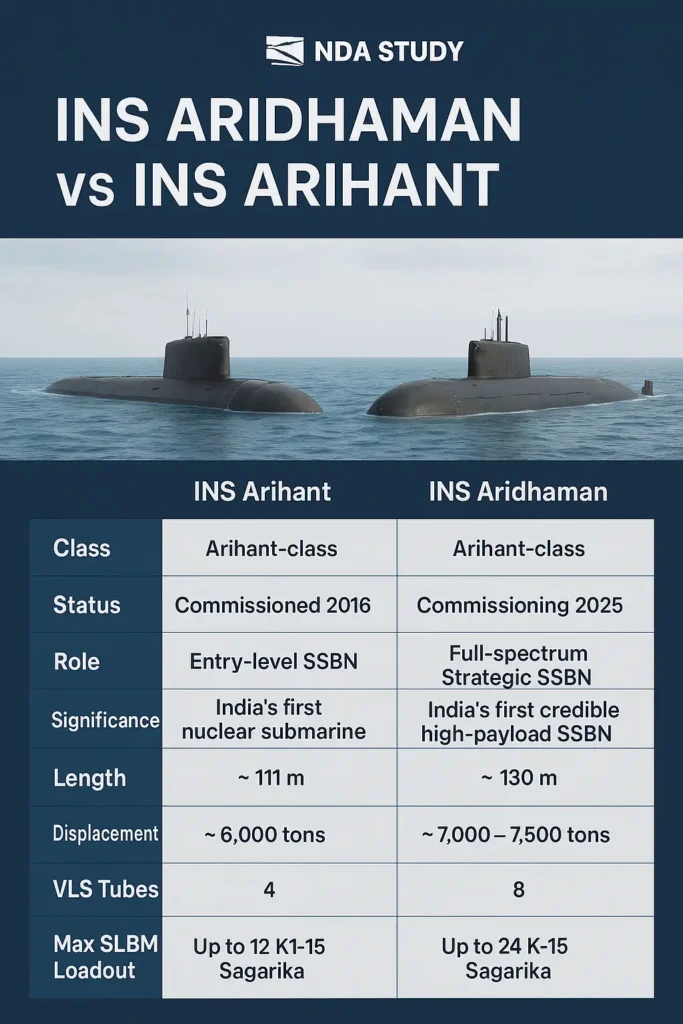
Comparing Aridhaman directly to its predecessor Arihant reveals the technological progression:
| Comparison Point | INS Aridhaman (S4) | INS Arihant (S2) | Upgrade Significance |
|---|---|---|---|
| Launch Tubes (VLS) | 8 | 4 | 100% increase in firepower |
| Primary Missile | K-4 (3,500 km) | K-15 (750 km) | 4.7× longer range |
| Total Missile Load | 8 K-4 OR 24 K-15 | 4 K-4 OR 12 K-15 | 2× capacity |
| Missile Range Advantage | 3,500 km transcontinental | 750 km regional | Transforms from regional to strategic |
| Reactor Type | CLWR-B1 (83 MW) | CLWR (83 MW) | Quieter, more efficient |
| Indigenous Content | 90% | ~65% | Self-reliance leap |
| Submerged Speed | 24 knots | 24 knots | Performance parity |
| Strategic Reach | Entire Indo-Pacific | Pakistan-focused region | Orders of magnitude difference |
What These Upgrades Mean Strategically
1. Doubled Firepower = Strategic Multiplier
Arihant was constrained to K-15 missiles for years. Limited to 750 km range, it primarily threatened Pakistan. Aridhaman debuts with K-4 as standard armament, providing 3,500 km transcontinental reach. One Aridhaman patrol carries equivalent firepower to two Arihant patrols.
2. K-4 Range Revolution = Transcontinental Reach
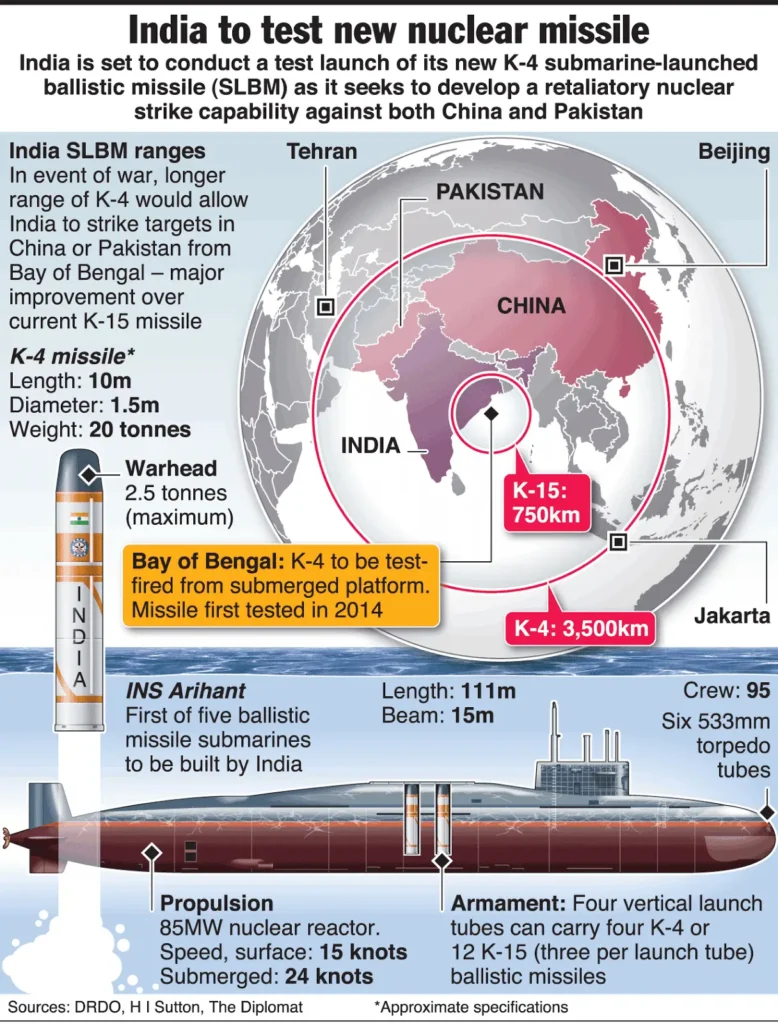
A submarine armed with K-4 missiles operating in the Bay of Bengal can strike any target within 3,500 km radius. This includes:
- All major Chinese cities (Beijing, Shanghai, Guangzhou)
- Entire Pakistan territory
- Significant Middle Eastern reach
- Strategic coverage of Southeast Asian sea lanes
3. 90% Indigenous = Self-Reliance Milestone
Arihant (65% indigenous) required Russian assistance on reactor design. Aridhaman (90% indigenous) demonstrates complete Indian mastery. DRDO, L&T, Tata, and BARC have fully integrated nuclear submarine design capability. Next-generation S5-class submarines are targeted at 100% indigenous design.
Global Context: How India’s SSBN Fleet Compares Internationally
To appreciate INS Aridhaman submarine commissioning 2025 significance, comparison with world nuclear powers provides essential context:
| Country | Active SSBNs | SSBN Class | Missile Type | Missile Range | Strategic Status |
|---|---|---|---|---|---|
| USA | 14 | Ohio-class | Trident II D5 | 12,000+ km | Continuous global patrols |
| Russia | 6+ | Borey-class | Bulava RSM-56 | 12,000 km | Arctic region operations |
| France | 4 | Triomphant-class | M51.1/M51.2 | 8,000–9,000 km | 1 always on patrol |
| UK | 4 | Vanguard-class | Trident II D5 | 12,000+ km | 1 always on patrol |
| China | 6+ | Jin-class | JL-2/JL-3 | 7,000–10,000 km | Rapidly expanding |
| India | 2 operational; Aridhaman building; S4* planned | Arihant-class | K-4 | 3,500 km | Transitioning to continuous deterrence |
Note: 4th SSBN (S4*, launched October 2024) commissioning 2027–2028
Strategic Analysis: India’s Position and Trajectory
Current Reality (2025):
- India operates only one fully operational SSBN (INS Arihant)
- China operates 6+ Jin-class SSBNs with longer-range missiles
- USA operates 14 Ohio-class with 12,000+ km missiles
- India significantly behind in numbers, but quality rapidly advancing
Aridhaman’s Impact:
- Moves India from “nascent capability” status to “credible deterrent”
- 8 K-4 tubes provide different threat profile than China’s JL-3
- Continuous at-sea deterrence prevents Chinese strategic advantage
- India achieves qualitative leap even without numerical parity
Future Trajectory (2027–2030):
- 4th SSBN (S4*, launched October 2024) commissioning 2027–2028
- Possible S5-class submarines: 10,000+ tonnes, 100% indigenous, extended missile capacity
- SSN program (Project-77): 6 nuclear attack submarines in development
- By 2035: India could operate 4–5 SSBNs (still smaller than China but genuinely credible)
The K-4 Missile: Technical Heart of Aridhaman’s Deterrent
The K-4 (Kalam-4) missile, named after former President Dr. APJ Abdul Kalam, represents India’s submarine-launched ballistic missile (SLBM) technological breakthrough. Understanding K-4 is essential to understanding Aridhaman’s strategic value.
K-4 Technical Specifications
Physical Characteristics:
- Length: 12 meters (39 feet)
- Diameter: 1.3 meters (4 feet 3 inches)
- Weight: Approximately 17 tonnes (fully loaded)
- Warhead: Single thermonuclear warhead (~2 tonnes)
Performance Parameters:
- Range: 3,500 kilometers (2,150 miles) standard configuration
- Extended Range: 4,000+ kilometers (with reduced warhead)
- Flight Time: Approximately 21 minutes to maximum range
- Accuracy: Circular Error Probable <10 meters (estimated)
Propulsion and Guidance:
- Two-stage solid-rocket motor with composite casings
- Inertial Navigation System (INS) primary guidance
- GPS/NavIC satellite positioning (indigenous Indian system)
- 3D maneuverable trajectory (evades ballistic missile defense)
Development and Testing:
- Designed and developed by Defence Research and Development Organisation (DRDO)
- Multiple successful test flights from land-based ranges
- Successfully test-fired from INS Arighaat in November 2024
- Status: Operationally proven and deployment-ready
Why K-4 Range Matters
A 3,500 km range from the Bay of Bengal provides Aridhaman extraordinary strategic reach:
Geographic Coverage From Bay of Bengal:
- China: Beijing (2,400 km), Shanghai (2,600 km), Guangzhou (2,200 km)—all within range
- Pakistan: Entire territory covered
- Middle East: Extended regional reach into Persian Gulf
- Southeast Asia: Covers strategic sea lanes and chokepoints
Strategic Implication: One Aridhaman patrol provides deterrence covering nearly the entire Indo-Pacific region. This geographic reach multiplies India’s strategic deterrent by orders of magnitude.
K-4 vs. K-15: Evolution of India’s SLBM Arsenal
| Missile | K-15 Sagarika | K-4 (Kalam-4) | Strategic Significance |
|---|---|---|---|
| Range | 750 km | 3,500 km | K-4 is 4.7× longer |
| Primary Platforms | Arihant, Arighaat | Aridhaman, future SSBNs | K-4 on newest boats |
| Warhead | Single nuclear | Single thermonuclear | Equivalent capability |
| Guidance | INS-based | INS + NavIC (indigenous) | Better precision, indigenous nav |
| Status | Deployed since 2016 | Operationally proven 2024 | K-4 represents evolution |
| Threat Coverage | Regional (Pakistan-focused) | Continental (Indo-Pacific) | Orders of magnitude difference |
The Bottom Line: K-4 represents generational leap in India’s submarine deterrent. From regional missile to transcontinental weapon system. From Pakistan-focused to India-China strategic balance.
Strategic Implications: How Aridhaman Reshapes India’s Regional Position
The commissioning of INS Aridhaman, India’s third indigenous nuclear-powered ballistic missile submarine (SSBN), fundamentally reshapes India’s regional position by:
Transformed Second-Strike Guarantee
Before Aridhaman, India’s second-strike capability was theoretical. With only one or two operational SSBNs, India could rarely maintain continuous deterrence. Aridhaman changes this vulnerability into strategic certainty.
The Current Vulnerability:
- India cannot guarantee one submarine always on patrol
- Maintenance, refit, crew rotation create gaps
- Enemy could miscalculate during these windows
- Strategic credibility: questionable
Aridhaman’s Solution:
- Three SSBNs enable one always at sea (rotation: patrol → maintenance → training)
- Location unknown, position unknowable
- Pre-emptive strike impossible
- Retaliation guaranteed regardless of first strike
- Strategic credibility: absolute
This transformation—from gap-prone deterrence to continuous guarantee—is revolutionary. It joins India with USA, Russia, France, and UK in exclusive continuous deterrence club.
Impact on India-China Strategic Balance
China’s expanding SSBN fleet presents India with strategic challenge. China operates 6+ Jin-class SSBNs armed with JL-3 missiles (10,000 km range). Aridhaman narrows this gap:
Current Disparity:
- China: 6+ SSBNs, JL-3 (10,000 km), continuous operations
- India: 1 SSBN, K-15 (750 km), sporadic patrols
- Strategic imbalance: Significant
With Aridhaman (2026–2027):
- India: 3 SSBNs, K-4 (3,500 km), continuous deterrence
- China: 6+ SSBNs, JL-3 (10,000 km), continuous operations
- Strategic imbalance: Narrowing
Long-term Trajectory:
- S5-class SSBNs in development: 10,000+ km missiles planned
- By 2035: India could match China’s continuous deterrence capability
- Strategic balance: Shifting toward multipolar deterrence
China’s strategic advantage, significant today, faces eventual challenge from India’s rapidly advancing SSBN program.
Impact on India-Pakistan Deterrence
Pakistan pursues sea-based deterrence through submarines and cruise missiles. Aridhaman changes Pakistan’s strategic calculus:
Pakistan’s Defensive Response:
- Aridhaman’s 3,500 km range covers entire Pakistan
- Pakistan cannot match India’s technological capability
- Pakistan must expand nuclear arsenal defensively
- Regional arms race acceleration likely
Strategic Stability Implications:
- Increased pressure on India-Pakistan crisis management
- Need for bilateral communication protocols
- Risk of miscalculation higher during tensions
- Essential: India-Pakistan confidence-building measures
The Paradox: Aridhaman strengthens India's deterrence while potentially destabilizing regional environment. Managing this requires diplomatic sophistication alongside military capability.
Indo-Pacific Strategic Shift
Aridhaman signals India’s emergence as world-class naval nuclear power:
QUAD Implications:
- India becomes stronger Quad partner (with Japan, Australia, USA)
- Shared Indo-Pacific security interests align better
- India can contribute more meaningfully to regional stability
- USA appreciates stronger India-China balance
Freedom of Navigation:
- Indian SSBNs support freedom of navigation operations
- Submarines demonstrate India’s presence across ocean
- Challenges China’s regional maritime dominance
- Supports open ocean access principles
Strategic Autonomy:
- India less dependent on Western security guarantees
- Can pursue independent strategic interests
- Maintains peaceful no-first-use posture
- Backed by unshakeable deterrent
FAQs | INS Aridhaman submarine commissioning 2025
1. When exactly will INS Aridhaman be commissioned?
Navy Chief Admiral Dinesh K. Tripathi announced on December 2, 2025, that Aridhaman is in final sea trials and will be commissioned around 2026–2027. Exact date depends on weapons system validation and reactor final checks. Official announcement will likely come in 2026, with commissioning following within 12 months.
2. What makes an SSBN different from regular submarines?
SSBN (Ship Submersible Ballistic Nuclear) is a nuclear-powered submarine armed with long-range nuclear-capable ballistic missiles. Unlike diesel-electric submarines requiring surface air intake, SSBNs use nuclear reactors enabling months-long underwater patrols. This invisibility makes SSBN deterrence credible—enemy cannot target what it cannot locate.
3. How far can K-4 missiles reach from Aridhaman?
K-4 missiles have 3,500 kilometer range, allowing Aridhaman operating in Bay of Bengal to strike targets throughout Indo-Pacific region including China, Pakistan, Middle East, and Southeast Asia. This transcontinental reach transforms India’s deterrent from regional to strategic scale.
4. How many missiles can Aridhaman carry?
Aridhaman has 8 vertical launch system (VLS) tubes, enabling:
– 8 K-4 missiles (3,500 km range) as primary configuration
– 24 K-15 Sagarika missiles (750 km range) as alternative
– Mixed configuration combining both types
5. How does Aridhaman compare to China’s submarines?
China operates 6+ Jin-class SSBNs with JL-3 missiles (10,000 km range). China’s fleet is numerically larger with longer-range missiles. However, Aridhaman represents India’s qualitative leap. By 2027 with 4 SSBNs, India will have credible (though smaller) deterrent matching China’s continuous operations.
6. What does “Aridhaman” mean?
“Aridhaman” is Sanskrit meaning “foe destroyer” or “enemy vanquisher.” India follows tradition of naming warships after warrior names from Hindu mythology and history, reflecting national heritage while emphasizing strategic purpose.
7. Why is Aridhaman larger than Arihant?
Aridhaman has 8 launch tubes versus Arihant’s 4, requiring larger hull capacity. The slightly heavier displacement (7,000 tonnes vs. Arihant’s 6,000) is offset by more advanced reactor efficiency maintaining performance and stealth characteristics.
8. How long can Aridhaman stay underwater?
Aridhaman can remain submerged for months—limited only by crew endurance and food supplies, not fuel. Nuclear reactor provides virtually unlimited propulsion, enabling extended ocean patrols without surfacing. This extended endurance is fundamental to continuous deterrence capability.
9. Is Aridhaman completely Indian-made?
Aridhaman is 90% indigenous—highest percentage among Indian SSBNs. Core design, construction, reactor systems, and integration are entirely Indian. Remaining 10% includes specialized sensors and components from international sources. Next-generation submarines target 100% indigenous design.
10. When will India have 4 operational SSBNs?
The 4th SSBN (S4*, SSBN 83) was quietly launched in October 2024. Expected commissioning: 2027–2028. By late 2020s, India could operate 4 SSBNs simultaneously—historic achievement demonstrating rapid capability advancement. S5-class submarines in development could follow around 2030–2035.
Why INS Aridhaman Submarine Commissioning 2025 Matters
The announcement of INS Aridhaman submarine commissioning 2025 represents far more than defense headline. It signals India’s transformation from aspiring nuclear power to established strategic power. Three dimensions matter most:
Military Dimension
Aridhaman provides India with unshakeable second-strike guarantee. Previous generations of submarines couldn’t maintain continuous patrols. Aridhaman enables rotation ensuring one submarine always at sea, location unknown, capable of devastating retaliation. This transforms deterrence from theoretical to absolutely practical. No adversary can risk pre-emptive strike against invisible submarine carrying transcontinental nuclear missiles.
Technological Dimension
Aridhaman demonstrates complete indigenous mastery over complex naval nuclear propulsion. 90% indigenous content means DRDO, L&T, Tata, and BARC have fully integrated world-class submarine design capability. This self-reliance in cutting-edge defense technology reduces foreign dependency, strengthens strategic autonomy, and establishes India as technological peer of established powers.
Geopolitical Dimension
Aridhaman redistributes Indo-Pacific power away from unipolarity. China’s expanding SSBN fleet faces Indian counter-capability. USA appreciates stronger India as balance against Chinese expansion. Japan and Australia gain stronger Quad partner. India gains voice in regional security architecture. Traditional unipolar dominance gives way to multipolar deterrence.
NDA Study’s Words : India’s Strategic Transformation
December 2, 2025, will likely be remembered as inflection point in India’s strategic history. Navy Chief Admiral Dinesh K. Tripathi’s announcement that INS Aridhaman submarine commissioning 2025 is imminent marks transition from emerging to established nuclear power.
For the first time, India will operate three SSBNs simultaneously, achieving 24/7 credible nuclear deterrence. The submarine carries 8 K-4 missiles with 3,500 km transcontinental range, 90% indigenously designed, proving India’s complete mastery over nuclear naval propulsion. This isn’t incremental improvement—it’s transformational leap.
Looking Forward:
- 2026–2027: INS Aridhaman commissioning (S4)
- 2027–2028: S4* SSBN commissioning (S5)
- 2030–2035: S5-class next-generation SSBNs (10,000+ km missiles)
- Long-term: Project-77 nuclear attack submarines (SSN program)
India’s path is clear. By 2035, India could operate 4–5 SSBNs backed by next-generation submarines and attack boats. Still smaller than China numerically, but genuinely credible globally.
For UPSC/defense aspirants: INS Aridhaman submarine commissioning 2025 represents critical exam material. It demonstrates India's strategic autonomy, indigenous R&D capability, credible minimum deterrence doctrine, and naval modernization ambitions—core topics for competitive defense examinations.
INS Aridhaman isn’t just a submarine. It’s India’s statement: “We are strategic power now. Our deterrent is credible. Our technology is sovereign. Our peace is backed by unshakeable strength.”
In strategic competition, that matters profoundly.
![Bharat Forge Develops Fully Indigenous Naval Propulsion System for Indian Navy [Explained]](https://ndastudy.com/wp-content/uploads/2026/01/Bharat-Forge-Develops-Fully-Indigenous-Naval-Propulsion-System-for-Indian-Navy-300x169.webp "Bharat Forge Develops Fully Indigenous Naval Propulsion System for Indian Navy [Explained] 5")