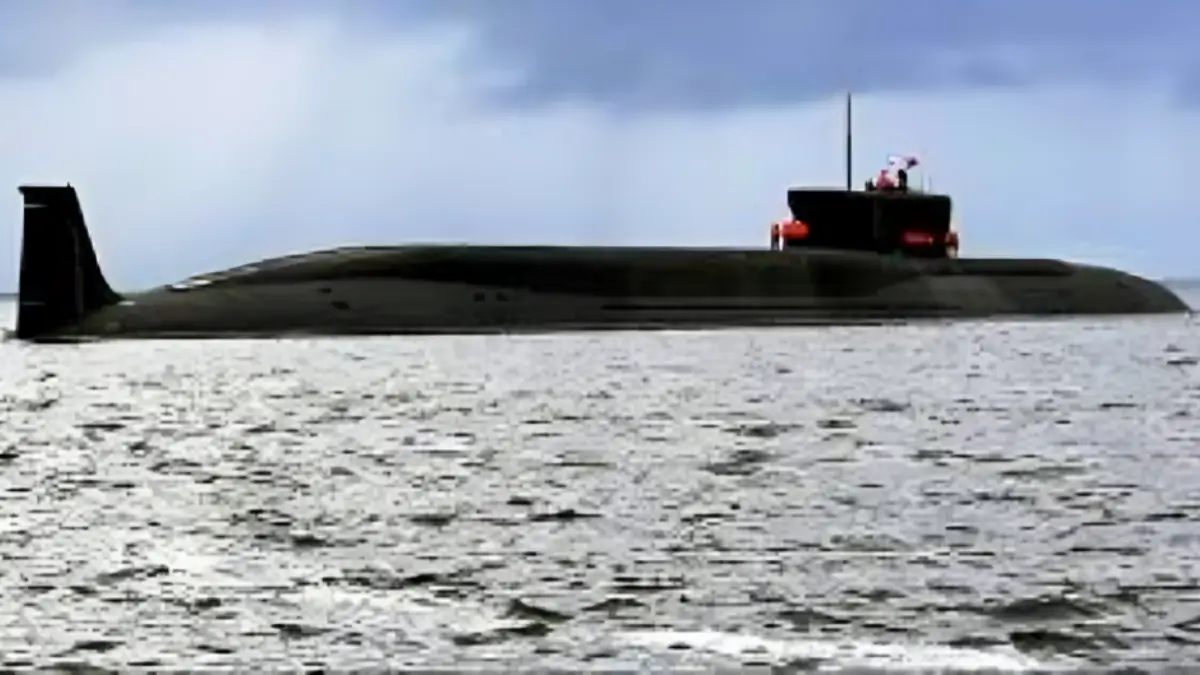
India possesses one of the world’s most sophisticated submarine-launched ballistic missiles: the K-4 Kalam. This missile is the backbone of India’s nuclear deterrence strategy, ensuring that even if adversaries destroy India’s entire air force on the ground, India can still retaliate with nuclear weapons from submarines hidden deep in the ocean. This capability is called second-strike deterrence, and it prevents war because attackers know they cannot win.
Recent developments have intensified focus on the K-4 SLBM system. India issued a Notice to Airmen (NOTAM) on November 27, 2025, declaring a 1,695-kilometer danger zone in the Bay of Bengal for missile tests scheduled between December 1-3, 2025. This NOTAM signals India’s testing of the K-4 alongside the Dhvani hypersonic glide vehicle, both critical components of India’s strategic arsenal. Simultaneously, China deployed its fourth spy vessel, the Yuan Wang-5, to monitor these tests, underlining the geopolitical significance of submarine-based deterrence.
Understanding the K-4 SLBM is essential for grasping India’s strategic position in Asia and the broader implications for regional security.
What is the K-4 SLBM, and Why India Developed It
The K-4, named after former President APJ Abdul Kalam, is an indigenously developed submarine-launched ballistic missile designed by India’s Defence Research and Development Organisation (DRDO). An SLBM is fundamentally different from land-based or air-based missiles because it eliminates the vulnerability problem that plague traditional deterrence systems. While air-based missiles can be destroyed on the runway and land-based missiles can be eliminated in their silos if an enemy knows their location, submarine-based missiles are nearly impossible to detect before launch.
India’s strategic requirement was clear: develop a weapon system that ensures India can retaliate catastrophically even after absorbing a first strike. This is called credible minimum deterrence. The K-4 was the missing piece in India’s nuclear triad. Before the K-4, India had land-based Agni missiles and air-based delivery systems through Su-30MKI fighters. The K-4 completed the triad by adding a sea-based component that adversaries cannot preemptively destroy.
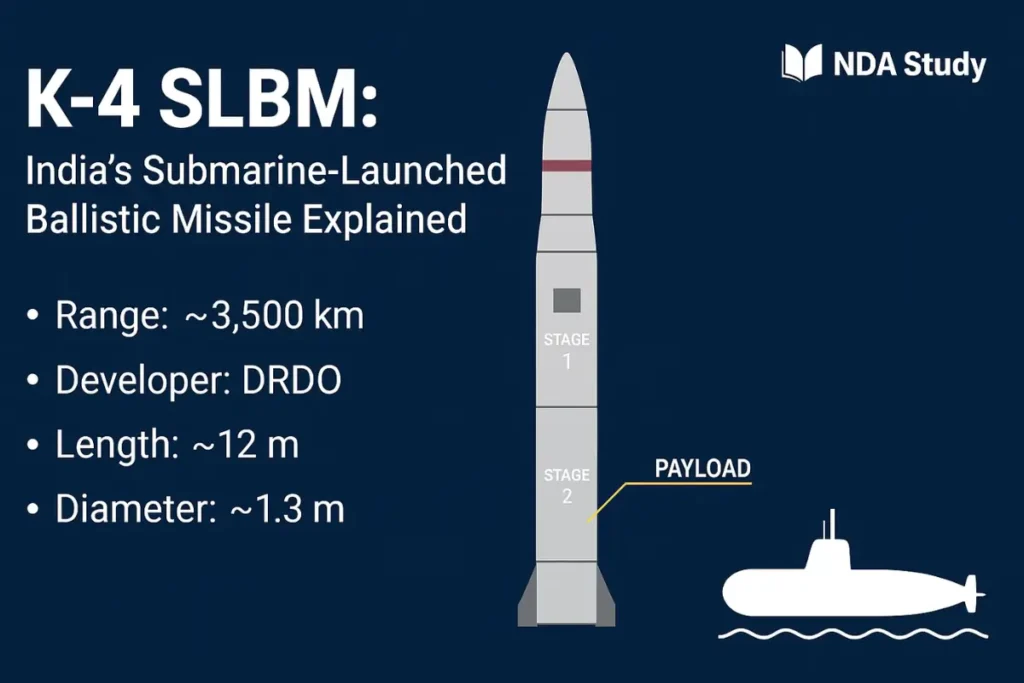
The technical specifications reveal why the K-4 is effective for India’s strategic needs. The missile has a range of 3,500 kilometers with full payload and up to 4,000 kilometers with reduced payload. This range covers all of Pakistan, Central Asia, the Middle East, and significant portions of China.
The missile is 12 meters long, weighs 17 tonnes, and carries a payload capacity of up to 2 tonnes, sufficient for both nuclear and conventional warheads. The circular error probable (CEP) is less than 10 meters, meaning 50 percent of missiles land within a 10-meter circle of the intended target. This precision is crucial because it enables precision deterrence: India can threaten specific military targets rather than entire cities, making the threat more credible and proportionate.
How K-4 Deployment Ensures Strategic Stability
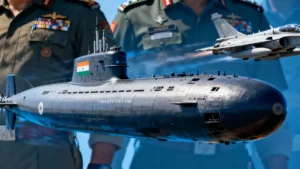
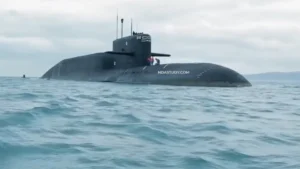
India maintains two Arihant-class nuclear submarines: INS Arihant and INS Arighaat. Each submarine carries approximately eight K-4 missiles in vertical launch tubes. The submarines operate on continuous patrol, with at least one submarine at sea at any given time. This ensures that no preemptive strike can eliminate India’s entire retaliatory capability. If Pakistan or China launches a nuclear attack on India, a submarine at sea automatically becomes India’s assured retaliation platform.
The deployment model involves the submarine remaining submerged and undetected in designated ocean zones. When launch orders are received from the Indian government, the launch sequence begins. The submarine surfaces slightly, depressurizes the launch tube, and ignites the K-4’s solid rocket motor. The missile exits the tube, breaks the water surface, and accelerates skyward. The first stage boosts the missile to extreme altitude and high velocity. After the first stage burns out and separates, the second stage ignites, accelerating the missile further. The missile then follows a ballistic arc, with the warhead separating during reentry and descending at hypersonic speeds toward the target.
The accuracy system uses an inertial navigation system (INS) for primary guidance, with GPS and NavIC satellite signals providing refinement. This hybrid approach ensures accuracy even in contested environments where adversaries might attempt to jam satellite signals. The missile achieves speeds exceeding Mach 6 during reentry, making interception with current air defense systems extremely difficult. While air defense systems like the S-400 have theoretical interception capability, the practical reaction window of less than five minutes makes reliable interception highly unlikely.
K-4 Compared to Global Peer Systems
Comparing the K-4 to similar systems worldwide provides important context. The United States operates the Trident II D5 missile with a range of 7,680 kilometers. Russia deploys the Bulava with a range of 8,300 kilometers. China operates the JL-2 with a range of 7,400 kilometers. France fields the M51 with a range of 8,000 kilometers. These systems have significantly longer ranges than the K-4’s 3,500 kilometers, but this reflects different strategic requirements. The United States, Russia, France, and the United Kingdom need to deter each other across global distances. India’s strategic requirement is regional deterrence against Pakistan and China, not global nuclear competition.
The K-4’s specifications are precisely suited to India’s strategic geography. A 3,500-kilometer range from the Arabian Sea or Bay of Bengal covers all major Pakistani cities and military installations, and parts of northern China. The missile doesn’t need to strike the United States or Europe. India’s deterrent works if it ensures that Pakistan and China face unacceptable retaliation costs from conventional military aggression. The warhead capacity of 2 tonnes supports nuclear warheads in the 200-kiloton range, sufficient to destroy major cities or military complexes. This is adequate for credible minimum deterrence without requiring the thousands of warheads that the United States and Russia maintain.
Historical Development and Test Timeline
The K-4 program dates back to the 1990s, but concrete development accelerated in the 2000s. The first successful K-4 test occurred in February 2020 from the INS Arihant submarine. This test was groundbreaking because it demonstrated that India could successfully launch a strategic missile from a submerged platform, the most difficult technical achievement in ballistic missile development. The missile traveled 3,500 kilometers, hit its target area with acceptable accuracy, and recovered successfully. This test confirmed that India had successfully developed an indigenous SLBM capability.
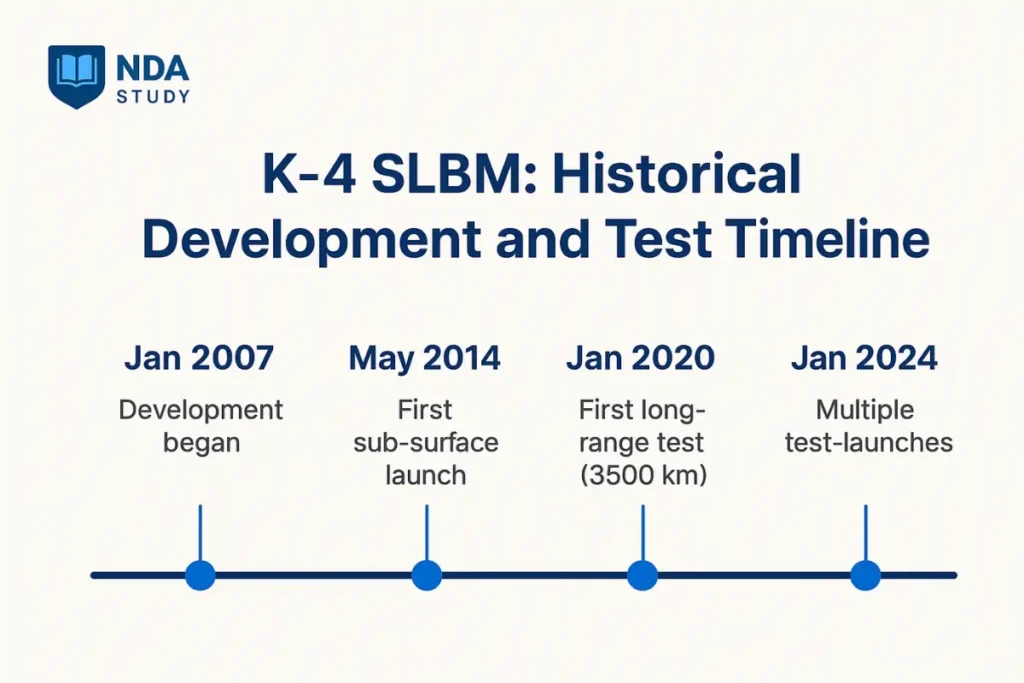
The second K-4 test occurred in October 2021, again from INS Arihant. This second successful test validated that the first test was not an anomaly and that the system had consistent performance characteristics. India confirmed the missile’s reliability through this repeated demonstration. The third test occurred in November 2024 from INS Arighaat, India’s second nuclear submarine. This test was particularly significant because it demonstrated that the K-4 could be successfully launched from different submarine platforms, indicating that the system was generalizable across the Arihant-class submarine fleet.
The December 2025 test, announced via NOTAM, will likely involve validation of new warhead designs or updated guidance systems. India conducts these regular tests every 18 to 24 months to maintain operational readiness and validate system improvements. Each test provides data that feeds into incremental improvements in accuracy, reliability, and warhead design. Future variants include the K-4 Mk2 with enhanced range (4,000+ kilometers), improved accuracy, and potentially multiple warheads. Longer-term development includes the K-5 with extended range (5,000 kilometers) for deeper ocean patrols and potential K-6 variants with hypersonic capabilities.
Strategic Implications for Asia’s Balance of Power
The K-4 SLBM represents a fundamental shift in Asia’s strategic balance. Before the K-4, India’s nuclear deterrent was primarily land-based, creating vulnerabilities if those missiles were discovered and targeted. Pakistan and China could theoretically plan disarming first strikes if they believed they could destroy India’s nuclear arsenal before it was launched. The K-4 eliminates this possibility. With submarines continuously at sea carrying nuclear missiles, India has assured second-strike capability. No conceivable first strike by Pakistan or China can eliminate India’s ability to retaliate catastrophically.
| Specification | Direct answer |
|---|---|
| System name | S-400 Triumf |
| NATO reporting name | SA-21 Growler. |
| Country of origin / Designer | Russia — Almaz-Antey. |
| Role | Mobile, long-range surface-to-air / anti-ballistic missile system. |
| Primary radars / sensors | 92N6/91N6 family + 96L6 etc. (multi-function & panoramic radars). |
| Radar maximum detection (reported) | Up to ~340–600 km depending on target RCS and radar model (widely quoted). |
| Interceptor missiles (common types) | 40N6 (~250–400 km claimed); 48N6 family (~150–250 km variants); 9M96/9M96E2 (shorter, high-precision ~40–120 km). (Ranges are reported/variant-dependent). |
| Engagement altitude (reported) | Up to ~27–30 km (aerodynamic targets); ballistic intercept ranges lower for TBMs. |
| Maximum target velocity (reported) | Up to ~4.8–5.0 km/s (ballistic target envelope reported). |
| Warhead / missile weight (representative) | Varies by missile: e.g., 48N6 ≈ ~1.8–1.9 t; 9M96 ≈ ~0.3–0.4 t (reported). |
| Guidance modes | Semi-active radar homing (older missiles); active radar homing for 40N6 and 9M96E2 (reported). |
| Mobility / launcher | Road-mobile TELs on wheeled chassis (batteries are mobile and road-deployable). |
| Reaction / readiness time (reported) | From march: ~5 min to ready on the move; from standby: seconds–minutes (varies by config). |
| Simultaneous targets / guided missiles (full system, reported) | ~36 targets tracked / up to ~72 missiles guided (system level figures reported). |
| In service / first deployment | 2007 – present (entered service ~2007). |
| Export / notable operators | Export customers include China, India, Turkey, Belarus, Algeria, etc. (contracts/deliveries vary). |
For Pakistan, the K-4 means that military aggression against India becomes irrational. The cost of an India-Pakistan war is now so high that rational policymakers in Pakistan will avoid conventional military conflict. This is deterrence working as intended: preventing war through the threat of unacceptable retaliation. For China, the K-4 levels the strategic playing field. While China maintains numerical superiority in nuclear warheads, India’s submarine-based missiles ensure that India has sufficient deterrent capability to make Chinese military adventurism unacceptable.
For regional stability, the K-4 is stabilizing because it removes incentives for preemptive first strikes. If India’s deterrent were vulnerable, adversaries might be tempted to strike first to eliminate the threat. With submarines constantly at sea, no first strike can succeed. This creates stable mutual deterrence, which is paradoxically more likely to prevent war than either side being vulnerable. For the global system, the K-4 represents the maturation of India as a strategic power with independent nuclear capability. India is no longer a client state dependent on superpower protection but a permanent member of the nuclear club with independent deterrent capability.
FAQs | K-4 SLBM specifications India
1. Is the K-4 missile fully operational?
The K-4 has completed multiple successful test launches and is in operational deployment with Indian Navy submarines. Exact deployment numbers remain classified, but submarines on regular patrols carry K-4 missiles as part of India’s continuous at-sea deterrent operations. The system is operationally ready for immediate use if required by national leadership.
2. How many K-4 missiles does India currently possess?
Exact numbers are classified for security reasons, but informed estimates suggest India has 12 to 16 operational K-4 missiles deployed across two submarines, with additional missiles in production or reserve. As India builds additional Arihant-class submarines, the total inventory will increase substantially.
3. Can current air defense systems shoot down the K-4 missile?
Current air defense systems like the S-400, Patriot, or THAAD have theoretical interception capability against ballistic missiles. However, the K-4’s Mach 6+ reentry speed and unpredictable trajectory during the final phase make reliable interception extremely difficult. The reaction window for air defenses is typically 10 to 15 minutes for ballistic missiles, providing a reasonable probability of interception. However, when multiple submarines launch multiple missiles simultaneously, saturating air defenses becomes nearly impossible.
4. What is the next evolution of the K-4 missile system?
The K-4 Mk2 is in development with planned enhancements including extended range (4,000+ kilometers), improved accuracy, and potential multiple independently targetable reentry vehicle (MIRV) capability. The K-5, planned for deployment in the 2030s, will have extended range (5,000 kilometers) for deeper ocean patrols. Long-term plans include the K-6 variant, potentially incorporating hypersonic technology if such systems mature.
5. How does India’s submarine-based deterrent compare to that of other nuclear powers?
India’s submarine-based deterrent is comparable in reliability to the British Vanguard-class submarines carrying Trident missiles or the French Triomphant-class submarines carrying M51 missiles. India’s system is less sophisticated than American Ohio-class submarines or Russian Borei-class submarines in some respects but adequate for India’s strategic requirements. The key is ensuring that at least one submarine is always at sea with operational missiles, which India achieves through its deployment rotation.
Conclusion
The K-4 SLBM represents the culmination of India’s strategic nuclear program, completing a credible deterrent triad with land-based and air-based components. The missile ensures that India can never be coerced through nuclear threat or defeated through military aggression. For the next 50 years, the K-4 and its variants will be the foundation of India’s strategic deterrence. As India builds more Arihant-class submarines and develops advanced variants, this deterrent capability will only strengthen, cementing India’s position as a permanent strategic power in Asia.
The recent NOTAM for December 2025 tests signals India’s continued commitment to validating and improving this crucial system. Each test, each new submarine, and each capability enhancement demonstrates India’s resolve to maintain a credible, independent deterrent. In a region of potential conflict, this is perhaps the best guarantee of peace.
![Bharat Forge Develops Fully Indigenous Naval Propulsion System for Indian Navy [Explained]](https://ndastudy.com/wp-content/uploads/2026/01/Bharat-Forge-Develops-Fully-Indigenous-Naval-Propulsion-System-for-Indian-Navy-300x169.webp "Bharat Forge Develops Fully Indigenous Naval Propulsion System for Indian Navy [Explained] 4")